



%402x.svg)
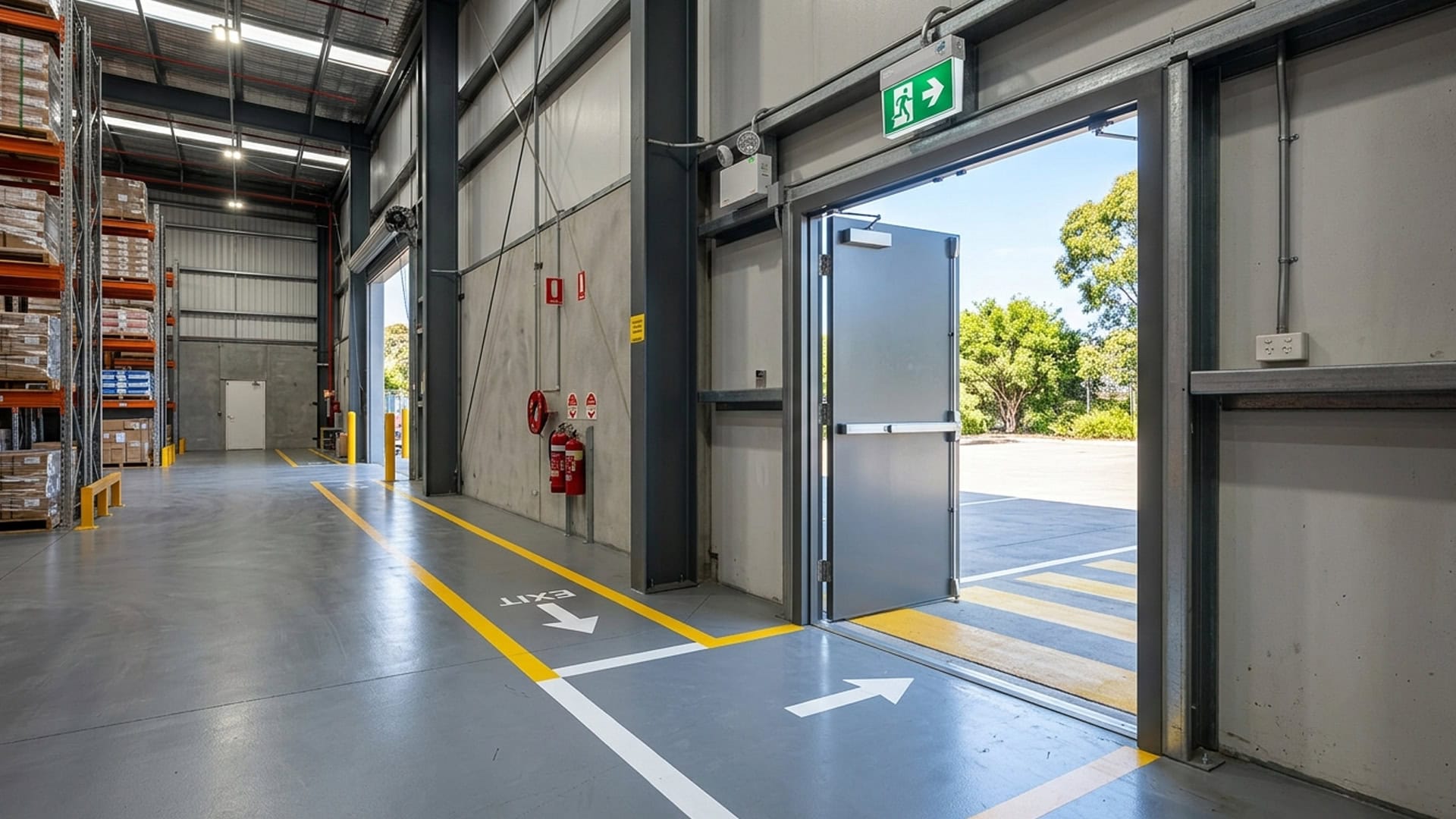

Emergency exit doors play a critical role in helping occupants leave a building safely during emergencies such as fires, smoke events, power failures, or other incidents requiring evacuation. Understanding emergency exit door requirements in Australia is important for builders, architects, warehouse operators, facility managers, and commercial property owners seeking to support safe building design and regulatory compliance.
This guide explains emergency exit door requirements in Australia, National Construction Code (NCC) considerations, fire safety requirements, sizing requirements, common applications, and practical compliance considerations for commercial and industrial buildings.
What Are Emergency Exit Door Requirements in Australia?
Emergency exit doors in Australia are generally required to:
- Provide a safe path of egress from a building
- Open in the direction of travel where occupant loads require it
- Remain readily openable without keys in emergency situations
- Be appropriately sized for anticipated occupant numbers
- Form part of a compliant exit system under the National Construction Code (NCC)
- Be clearly identified with appropriate exit signage where required
- Support emergency evacuation strategies and fire safety objectives
- Be maintained and regularly inspected throughout the life of the building
The exact requirements can vary depending on building classification, occupancy type, fire engineering design, travel distances, occupant loads, hardware configuration, and project-specific requirements.
What Is an Emergency Exit Door?
An emergency exit door is a door located on an evacuation route that enables occupants to leave a building safely during an emergency.
Emergency exit doors are commonly found in:
- Warehouses
- Factories
- Manufacturing facilities
- Distribution centres
- Office buildings
- Shopping centres
- Schools
- Hospitals
- Public buildings
- Multi-tenancy commercial developments
These doors can be configured in numerous ways depending on the building’s use, occupancy load, fire strategy, and security requirements.
Emergency exit doors are often referred to as:
- Fire exit doors
- Exit doors
- Emergency egress doors
- Commercial emergency exit doors
- Evacuation doors
Although these terms are frequently used interchangeably, their specific application can vary depending on the building design and regulatory context.
Why Emergency Exit Doors Matter
During an emergency, occupants need a clear and unobstructed path to safety.
A properly designed exit system can help:
- Support orderly evacuation
- Reduce congestion during emergencies
- Improve accessibility
- Assist emergency response procedures
- Support building fire safety strategies
- Help building owners manage regulatory obligations
Emergency exit doors form one component of a broader life safety system that may also include:
- Exit corridors
- Fire-rated walls
- Smoke control systems
- Emergency lighting
- Exit signage
- Fire detection systems
- Fire suppression systems
NCC Requirements for Emergency Exit Doors
The National Construction Code (NCC) provides performance requirements and deemed-to-satisfy provisions that influence emergency exit door design throughout Australia.
For current regulatory information, refer to the Australian Building Codes Board.
Key NCC Considerations
Emergency exit doors may need to address:
Safe Egress
Buildings are generally required to provide occupants with a safe means of evacuation.
Exit doors can be configured to support:
- Direct access to a road or open space
- Access to a fire-isolated exit
- Access to a protected path of travel
Door Operation
Emergency exit doors are commonly expected to be:
- Readily openable from the inside
- Capable of operation without specialised knowledge
- Suitable for emergency evacuation scenarios
Specific hardware requirements may vary depending on building classification and occupant load.
Direction of Opening
Certain buildings and occupancy arrangements may require doors to swing in the direction of egress travel.
This can assist evacuation flow and reduce congestion during emergencies.
Exit Route Continuity
Emergency exit doors typically form part of a continuous path of travel leading occupants to a place of safety.
The complete evacuation route should be considered rather than assessing individual doors in isolation.
Fire Safety Requirements for Emergency Exit Doors
Fire safety is a major consideration when selecting and configuring emergency exit doors.
The role of an emergency exit door can vary depending on where it is positioned within the building.
Some doors may primarily facilitate evacuation, while others may also form part of a fire compartmentation strategy.
Fire-Rated vs Fire Exit Doors
Many people assume all emergency exit doors must be fire-rated.
This is not necessarily the case.
Whether a door requires a fire resistance level depends on its location and function within the building design.
Learn more here:
Fire Door Hardware Considerations
Depending on the application, emergency exit doors may be configured with:
- Panic bars
- Exit devices
- Lever handles
- Door closers
- Hold-open devices
- Access control systems
- Emergency release mechanisms
Hardware selection should align with the evacuation strategy and project requirements.
Fire Brigade Guidance
Building owners and facility managers may also refer to guidance from local fire authorities.
Emergency Exit Door Sizing Requirements
One of the most common questions asked by project teams is:
What Size Should an Emergency Exit Door Be?
There is no single emergency exit door size that applies to every building.
Suitable sizing can depend on:
- Building classification
- Occupant load
- Travel distances
- Evacuation calculations
- Accessibility requirements
- Fire engineering strategies
- NCC provisions
Common Commercial Door Widths
Commercial emergency exit doors are frequently available in widths such as:
- 820mm
- 920mm
- 1020mm
- 1100mm
However, project-specific requirements may differ.
Accessibility Considerations
Exit doors often need to work alongside accessibility requirements.
Clear opening widths and circulation spaces can influence door selection.
Related reading:
Fire Exit Door Sizes
Where fire-rated exit doors are required, sizing options may be influenced by:
- Fire resistance requirements
- Door leaf configuration
- Hardware selection
- Structural opening dimensions
Further information:
Warehouse Emergency Exit Door Requirements
Warehouses often present unique evacuation challenges due to:
- Large floor areas
- High occupant movement
- Vehicle traffic
- Storage racking
- Multiple work zones
Warehouse emergency exit door requirements can vary depending on:
- Building size
- Occupancy numbers
- Fire safety design
- Travel distances
- Hazard classifications
For additional warehouse door requirements, you may refer to the Warehouse Door Sizing Guide.
Typical Warehouse Exit Door Considerations
Many warehouse operators seek door solutions that can support:
- Reliable day-to-day operation
- Emergency egress functionality
- Durability in industrial environments
- Compatibility with access control systems
- Integration with fire safety strategies
Industrial personal access doors are commonly used alongside larger industrial openings to provide dedicated pedestrian egress options.
Commercial Building Emergency Exit Door Requirements
Commercial buildings often require a more complex evacuation strategy than smaller facilities.
Examples include:
- Office towers
- Retail centres
- Educational facilities
- Healthcare buildings
- Mixed-use developments
Factors Influencing Exit Door Design
Commercial emergency exit doors may be configured based on:
- Occupant load calculations
- Building classification
- Accessibility requirements
- Security requirements
- Fire compartmentation strategy
- Operational requirements
Door systems can be selected and configured to support these project-specific objectives.
Choosing an Emergency Exit Door
When evaluating emergency exit door options, project teams commonly consider:
Durability
Industrial and commercial environments often benefit from robust door construction suitable for frequent use.
Hardware Compatibility
Emergency exit doors can be configured with a range of hardware options depending on evacuation and operational requirements.
Security Considerations
Many facilities seek solutions that balance emergency egress capability with controlled building access.
Environmental Conditions
External doors may require consideration of:
- Wind exposure
- Corrosion environments
- Weather resistance
- Cyclonic regions
Building Use
Different occupancy types may influence:
- Door size
- Hardware selection
- Fire performance requirements
- Accessibility provisions
Emergency Exit Door Compliance Checklist
Use this checklist as a starting point when reviewing emergency exit door requirements.
Emergency Exit Door Compliance Checklist
- Exit paths identified
- Occupant load assessed
- Travel distances reviewed
- Appropriate door sizing considered
- Accessibility requirements reviewed
- Door swing direction assessed
- Exit hardware selected
- Exit signage provided where required
- Emergency lighting considered
- Fire safety strategy reviewed
- Fire rating requirements assessed where applicable
- Maintenance program established
- Regular inspections scheduled
- Building-specific requirements reviewed
- NCC requirements verified
Because every project is different, final compliance outcomes should always be assessed against the applicable NCC provisions and project requirements.
Common Mistakes to Avoid
Assuming All Exit Doors Must Be Fire Rated
The requirement for fire resistance depends on the application and building design.
Choosing Doors Based Solely on Size
Door selection should consider evacuation requirements, accessibility, hardware, and overall building performance.
Ignoring Hardware Requirements
Hardware plays a significant role in how emergency exit doors function during evacuation.
Failing to Consider Future Occupancy
Building use can change over time, potentially affecting evacuation requirements.
Not Reviewing the Entire Exit Path
A compliant door alone does not guarantee a compliant evacuation route.
The entire path of travel should be considered.
Why Trust Larnec?
Emergency exits are critical components of building safety. Larnec supplies emergency exit door solutions for commercial, industrial and warehouse facilities across Australia. This article explains key emergency exit door requirements using practical industry knowledge alongside relevant Australian regulations.
Related Emergency Exit Door Resources
Emergency exit doors play a vital role in building safety by providing safe and efficient means of egress during an emergency. Understanding how emergency exits relate to fire doors, accessibility requirements and Australian building regulations can help ensure your facility remains compliant. The following guides provide additional information on emergency exit door requirements and related compliance topics:
- Commercial Fire Door Requirements Australia – Learn about commercial fire door requirements, certification considerations and compliance obligations for Australian buildings.
- DDA Door Requirements Australia – Learn about disability access requirements for doors and how accessibility considerations may apply to emergency exits in commercial buildings.
How Larnec Can Help
Larnec supplies industrial and commercial door solutions designed for demanding Australian environments.
Depending on the application, door systems can be configured to support:
- Emergency egress requirements
- Industrial facilities
- Warehouses
- Commercial buildings
- Accessibility objectives
- Fire safety strategies
- Cyclonic regions
- Project-specific hardware requirements
Because emergency exit door requirements vary significantly between projects, selecting the most suitable solution typically involves consideration of building classification, occupancy, hardware configuration, fire strategy, and site conditions.
If you’re planning a new facility or upgrading an existing building, the Larnec team can discuss options suitable for your application and help identify door configurations that align with your project’s objectives.
Frequently asked questions
Emergency exit door requirements generally involve providing a safe means of evacuation, appropriate door operation, suitable sizing, and integration into the building’s overall egress strategy under the NCC.
Certain buildings and occupant loads may require doors to swing in the direction of egress travel. Requirements depend on the specific application and NCC provisions.
Not necessarily. Hardware requirements vary depending on occupancy, building use, and project requirements.
No. Some emergency exit doors may require fire resistance, while others primarily function as evacuation doors.
Suitable door size depends on occupant load, accessibility requirements, building classification, and evacuation calculations.
A fire exit door supports evacuation, while a fire-rated door is designed to contribute to fire compartmentation. In some applications, a door may perform both functions.
Inspection frequency can depend on building type, maintenance procedures, and applicable regulatory requirements.
Many industrial door systems can be configured with different sizes, hardware options, finishes, and operational features depending on project requirements.