



%402x.svg)
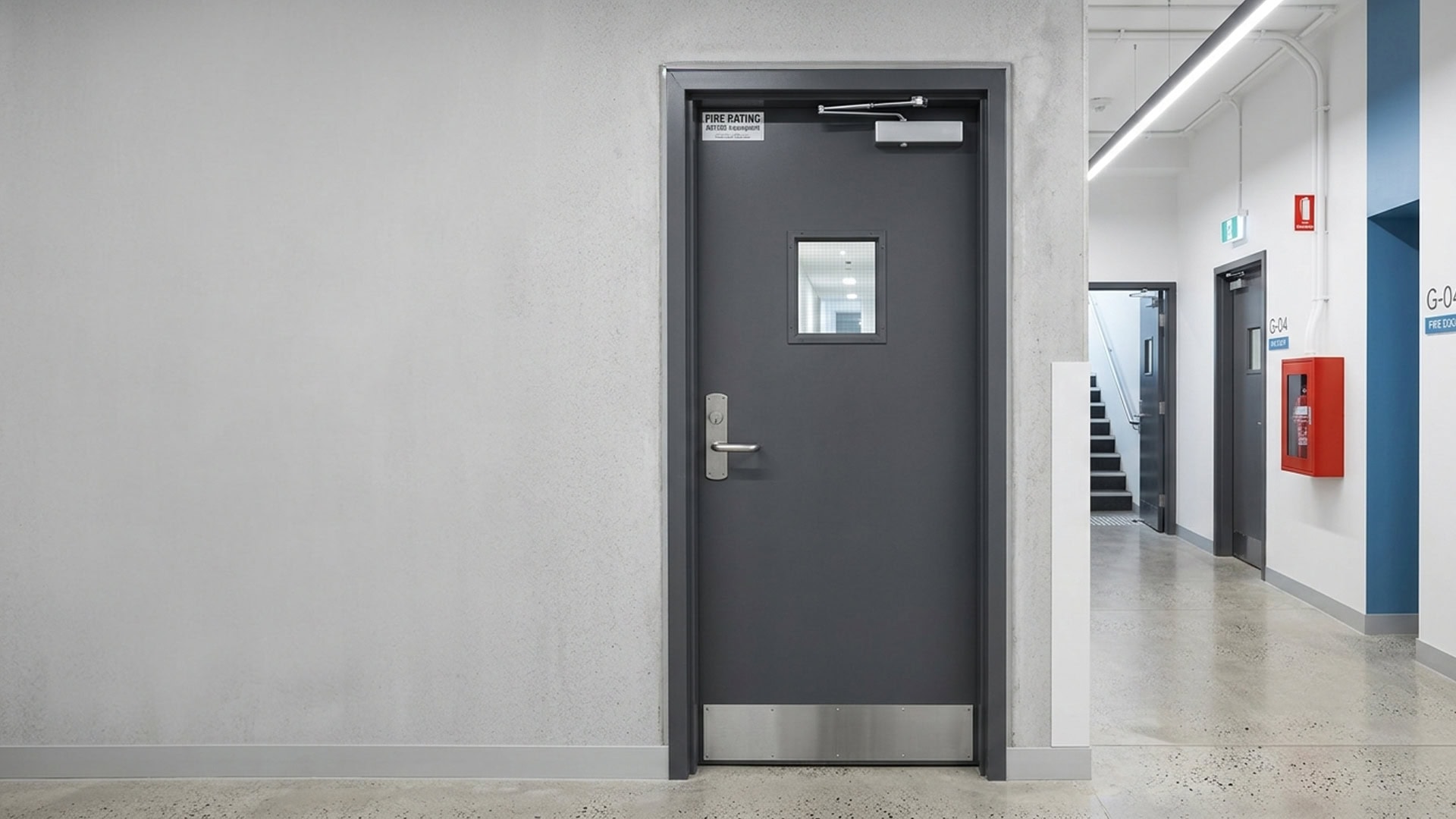

Commercial fire door requirements in Australia are governed by the National Construction Code (NCC), relevant Australian Standards, building classifications, and project-specific fire engineering requirements. Commercial fire rated doors are designed to support compartmentation strategies by helping slow the spread of fire and smoke between designated areas within a building.
Requirements can vary depending on:
- Building classification
- Fire-resistance level (FRL) requirements
- Door location
- Occupancy type
- Exit and egress pathways
- Hardware configuration
- Fire-rated wall systems
Commercial fire doors generally require appropriate certification, approved hardware, ongoing inspection, and maintenance to support their intended performance. Final compliance outcomes depend on the complete door assembly, installation method, hardware selection, and application.
Understanding Commercial Fire Door Requirements in Australia
Commercial buildings rely on multiple passive fire protection systems to help support occupant safety and property protection. One of the most important components is the fire door assembly.
A commercial fire door is designed to be installed within a fire-rated wall system to help delay the passage of fire, smoke, and heat between compartments for a specified period.
Rather than viewing a fire door as a standalone product, Australian regulations generally assess the complete assembly, including:
- Door leaf
- Frame
- Hinges
- Locks
- Closers
- Seals
- Vision panels (if applicable)
- Hardware
- Installation method
This means a door that may be suitable in one application might not be appropriate in another without the correct configuration.
What Is a Commercial Fire Rated Door?
A commercial fire rated door is a door assembly designed and tested to provide a specified level of fire resistance when installed as part of a fire-rated wall system.
These doors can be configured for a variety of commercial applications, including:
- Warehouses
- Factories
- Distribution centres
- Industrial facilities
- Office buildings
- Educational facilities
- Healthcare facilities
- Retail centres
- Multi-storey commercial buildings
The fire resistance capability of a door assembly is typically expressed through a Fire Resistance Level (FRL), which identifies how long the assembly may assist in maintaining its fire separation function under testing conditions.
For a detailed overview of fire-rated doors, read: https://www.larnec.com.au/resource-centre/what-are-fire-rated-doors-and-do-you-need-one-in-australia/
Why Fire Doors Are Important in Commercial Buildings
Commercial buildings often contain multiple compartments designed to limit fire spread.
Fire doors can help support these strategies by:
- Delaying fire spread between spaces
- Supporting evacuation pathways
- Protecting escape routes
- Assisting fire brigade access
- Helping reduce smoke movement
- Supporting broader building fire safety strategies
The effectiveness of these outcomes depends on correct specification, installation, operation, and maintenance.
NCC Requirements for Commercial Fire Doors
The National Construction Code (NCC) establishes performance requirements for fire safety in Australian buildings.
The NCC does not simply require a “fire door”. Instead, it identifies where fire-resisting construction may be required and what level of performance that construction should achieve.
Commercial fire door requirements commonly arise in:
- Fire-isolated exits
- Fire stairwells
- Service risers
- Plant rooms
- Fire compartments
- Hazardous storage areas
- Boundary wall openings
- Essential services rooms
The required solution depends on:
- Building classification
- Effective height
- Rise in storeys
- Occupancy type
- Fire engineering design
- Fire compartment layout
Project teams should always refer to current NCC provisions and project-specific documentation when determining requirements.
External reference: https://www.abcb.gov.au
Fire Door Standards Australia
Several standards contribute to fire door compliance throughout the building lifecycle.
These standards can address areas such as:
- Fire testing
- Installation
- Certification
- Inspection
- Maintenance
The applicable standards may vary depending on project requirements and jurisdictional obligations.
Because standards evolve over time, building owners, facility managers, architects, and contractors should ensure they are working from current versions and approved project documentation.
Commercial Building Fire Door Requirements
Commercial fire door requirements are typically determined during design and approval stages.
Factors that may influence specification include:
Building Classification
Different NCC building classifications may have different fire protection requirements.
Examples include:
- Offices
- Industrial facilities
- Warehouses
- Healthcare buildings
- Schools
- Retail developments
Fire Separation Requirements
Where fire-rated walls are required, openings within those walls frequently require compatible fire door assemblies.
Occupancy Risk
Higher-risk areas may require different levels of fire protection depending on:
- Stored materials
- Occupant density
- Building use
- Fire load
Exit Pathways
Doors located within evacuation routes may require consideration of:
- Opening direction
- Egress hardware
- Door width
- Accessibility requirements
- Smoke control strategies
Commercial Fire Door Sizing Considerations
One of the most common compliance questions relates to fire door sizing.
There is no single standard fire door size that applies to every commercial project.
Door dimensions may depend on:
- Building layout
- Occupancy load
- Accessibility requirements
- Egress calculations
- Fire compartment design
- Structural openings
Common considerations include:
Clear Opening Width
The NCC and accessibility requirements may influence minimum clear opening dimensions.
Evacuation Capacity
Larger occupant loads may require wider exit pathways.
Equipment Access
Industrial facilities and warehouses often require larger openings to accommodate operational requirements.
Fire Rating Compatibility
Door size can influence available fire-rated configurations and tested assembly options.
For detailed sizing information, see:
- https://www.larnec.com.au/resource-centre/fire-door-sizes-australia/
- https://www.larnec.com.au/resource-centre/fire-rated-vs-fire-exit-doors/
Fire Door Hardware Requirements
Hardware selection is a critical part of any commercial fire door assembly.
Typical components may include:
Fire-Rated Hinges
Hinges must generally be suitable for the intended fire-rated application.
Door Closers
Many fire doors are designed to self-close after opening.
The selected closer should be appropriate for the door size, weight, and intended use.
Locks and Latches
Hardware should support the door’s intended fire performance while also meeting operational requirements.
Smoke Seals
Some applications may require smoke control measures in addition to fire resistance considerations.
Vision Panels
Where visibility is required, specially configured fire-rated glazing systems may be incorporated into approved assemblies.
The final hardware selection should align with tested and approved door configurations.
Common Commercial Fire Door Compliance Mistakes
Many compliance issues arise not because the door itself is unsuitable, but because changes are made after installation.
Common mistakes include:
Installing Non-Approved Hardware
Replacing locks, closers, or hinges without assessing fire-rating implications can affect the overall assembly.
Propping Doors Open
Fire doors are designed to operate in a closed position during a fire event.
Propping doors open can compromise compartmentation strategies.
Unauthorised Modifications
Examples include:
- Cutting additional holes
- Installing unapproved glazing
- Adding cable penetrations
- Trimming beyond approved limits
Damaged Seals
Missing or damaged seals can affect intended performance.
Poor Maintenance
Lack of regular inspection can allow defects to remain undetected.
Missing Identification Tags
Fire door identification and certification requirements vary, but missing tags may create compliance concerns.
Fire Door Compliance Checklist
Use this practical fire door compliance checklist as a starting point.
Door Assembly
- Correct fire-rated door installed
- Compatible frame system
- Appropriate hardware
- Approved glazing (if applicable)
Operation
- Door self-closes correctly
- Door latches properly
- No obstruction to operation
- No excessive gaps
Condition
- No visible damage
- Seals intact
- Hardware secure
- Signage maintained
Documentation
- Certification records available
- Maintenance records retained
- Inspection records current
- Building documentation updated
This checklist is a guide only and should not replace professional assessment.
Inspection and Maintenance Requirements
Inspection and maintenance are essential components of fire door compliance.
Even a properly specified fire door can become unsuitable if not maintained.
Routine inspection programs commonly assess:
- Door operation
- Closing performance
- Latching functionality
- Seal condition
- Hardware condition
- Frame integrity
- Glazing condition
- Signage
- Certification identification
Building owners and facility managers should establish maintenance schedules aligned with applicable regulations and project requirements.
Additional guidance may be available through: https://www.fpaa.com.au
Fire Rated Doors vs Fire Exit Doors
Many people use the terms interchangeably, but they are not necessarily the same.
A fire-rated door focuses on compartmentation and fire resistance.
A fire exit door focuses on safe occupant egress.
Some door systems can be configured to support both functions, while others may only address one requirement.
Understanding this distinction is important during specification and compliance reviews.
Fire Rated Door vs Non-Fire-Rated Door
A standard commercial door may appear visually similar to a fire-rated door.
However, the differences can include:
- Tested construction methods
- Core materials
- Hardware requirements
- Certification processes
- Installation requirements
- Ongoing maintenance obligations
The appropriate choice depends on the building application and project requirements.
Read more: https://www.larnec.com.au/resource-centre/fire-rated-door-vs-non-fire-rated-door/
Choosing a Commercial Fire Door for Your Project
Selecting the right fire door involves more than choosing a rating.
Project teams should consider:
- Building classification
- Fire engineering requirements
- Opening size
- Hardware needs
- Accessibility requirements
- Environmental conditions
- Operational demands
- Maintenance expectations
Many commercial projects benefit from consulting experienced door manufacturers and fire safety professionals during the specification stage.
A properly configured solution can help support building performance objectives while aligning with project-specific requirements.
Why Trust Larnec?
Commercial fire doors must perform reliably when they are needed most. Larnec has extensive experience manufacturing steel-clad fire door solutions for commercial and industrial buildings throughout Australia. This guide explains fire door requirements using recognised Australian Standards and practical industry expertise.
Related Fire Door Compliance Resources
Commercial fire doors are a critical part of a building’s passive fire protection system. Understanding fire door requirements, sizing, emergency egress provisions and the differences between various fire door types can help ensure your building meets Australian compliance requirements. The following guides provide additional information on key fire door topics:
- Fire Doors in Escape Routes – Learn how fire doors support safe evacuation and why they are essential in designated escape routes.
- Emergency Exit Door Requirements Australia – Explore emergency exit door requirements, egress provisions and compliance obligations for commercial buildings.
- Door Regulations Australia – Learn about the key Australian building regulations, standards and compliance requirements that apply to commercial and industrial doors.
How Larnec Can Help
Larnec manufactures commercial and industrial door solutions for a wide range of Australian applications.
Depending on project requirements, fire-rated door options can be configured to support:
- Warehouses
- Factories
- Industrial facilities
- Commercial buildings
- Service areas
- Plant rooms
- Fire compartment openings
Because fire door requirements vary significantly between projects, selecting the most appropriate solution should consider the complete assembly, hardware specification, installation method, and intended application.
If you’re planning a new project, upgrading an existing facility, or reviewing fire door requirements, the Larnec team can assist with product information and specification guidance.
Frequently asked questions
Commercial fire door requirements are generally determined by the NCC, building classification, fire engineering requirements, and applicable Australian Standards. Requirements vary depending on location, use, and fire separation objectives.
Not all commercial buildings require fire doors in every location. Requirements depend on building design, compartmentation needs, and fire safety provisions.
A fire door is designed to support fire compartmentation, while a fire exit door primarily facilitates occupant evacuation. Some assemblies can be configured to support both functions.
Inspection frequency depends on building requirements, maintenance programs, and applicable regulations. Routine inspections are generally recommended to identify defects early.
Modifications may affect the performance of a fire-rated assembly. Any changes should be assessed against the approved configuration and project requirements.
Many fire-rated door applications require self-closing functionality. Requirements depend on the intended application and approved assembly configuration.
A door that fails to close and latch correctly may not perform as intended during a fire event and should be inspected promptly.
Compliance depends on the complete door assembly, installation, maintenance, hardware configuration, and applicable building requirements. Professional assessment may be required for confirmation.