



%402x.svg)
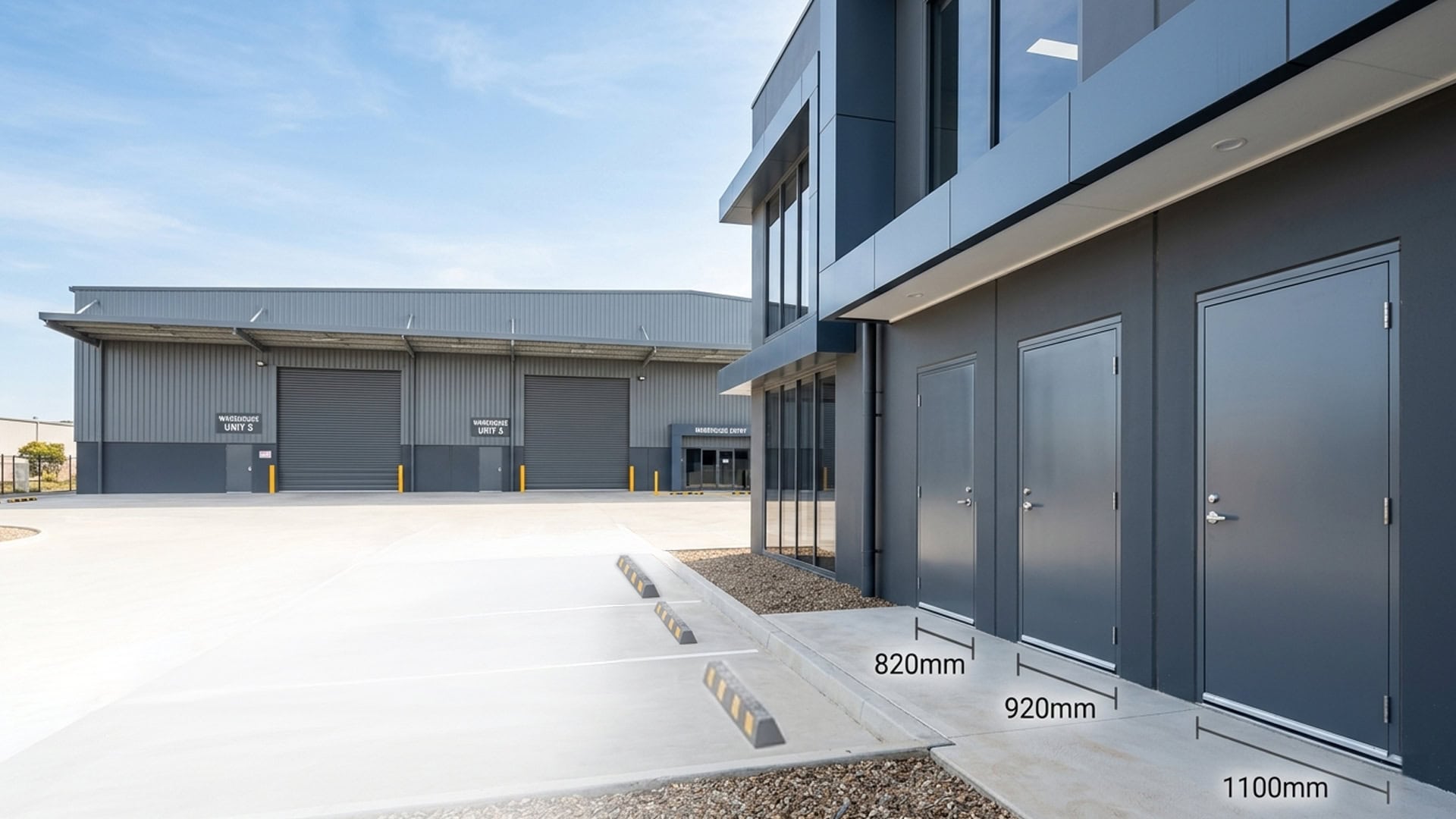

Commercial door sizes play an important role in the functionality, accessibility, and performance of industrial and commercial buildings. Whether you’re planning a warehouse, factory, office, workshop, retail premises, or storage facility, understanding common commercial door dimensions can help support better design decisions and project planning.
While there is no single commercial door size that suits every application, several standard dimensions are commonly used across Australia. The most suitable door size will depend on factors such as building use, accessibility requirements, traffic volumes, hardware selection, operational needs, and applicable regulations.
This guide explains common commercial door sizes in Australia, standard widths and heights, accessibility considerations, and how different building types may influence door selection.
What Is the Standard Commercial Door Size in Australia?
One of the most common questions building owners and project managers ask is:
What is the standard commercial door size?
In Australia, many commercial projects utilise door leaf sizes based on residential and industrial standards, with larger widths often selected to support increased traffic flow and operational requirements.
Common commercial door dimensions include:
| Door Width | Door Height |
|---|---|
| 820mm | 2040mm |
| 920mm | 2040mm |
| 1020mm | 2040mm |
| 1100mm | 2040mm |
| Custom sizes | Project specific |
The most suitable commercial door size depends on the intended application, required clear opening, hardware configuration, accessibility considerations, and building classification.
For a broader overview of Australian door dimensions, see our guide to Standard Door Sizes.
Common Commercial Door Widths
Commercial door width is often one of the most important considerations during specification.
Different widths can be configured to support varying levels of pedestrian traffic, equipment movement, accessibility requirements, and operational workflows.
820mm Commercial Doors
820mm wide doors are commonly used in:
- Utility rooms
- Plant rooms
- Service areas
- Staff-only access points
- Low-traffic applications
These doors can provide a practical solution where space constraints exist and traffic demands are relatively limited.
920mm Commercial Doors
920mm wide doors are frequently specified for:
- Warehouses
- Industrial facilities
- Commercial buildings
- Workshops
- Storage facilities
A wider opening may support easier movement of personnel, equipment, and materials while also assisting projects seeking improved accessibility outcomes.
1020mm and 1100mm Commercial Doors
Larger door widths are often selected for:
- High-traffic environments
- Public buildings
- Educational facilities
- Healthcare environments
- Industrial access points
These wider commercial door sizes can be configured to accommodate increased traffic volumes and operational requirements depending on the project.
Commercial Door Height Requirements
Commercial door height is another important consideration during design and specification.
Across many Australian commercial and industrial projects, a door height of 2040mm remains a commonly specified dimension.
However, larger openings may be selected where projects require:
- Increased clearance
- Enhanced accessibility
- Equipment movement
- Specialised operational requirements
- Custom architectural outcomes
Door frame design, threshold configuration, hardware selection, and installation conditions can all influence the effective opening dimensions achieved on site.
As a result, final door size selection should be assessed within the broader context of the overall opening and application.
Accessibility Considerations
Accessibility requirements can significantly influence commercial door size requirements in Australia.
Projects may need to consider:
- Clear opening widths
- Door hardware selection
- Threshold design
- Opening forces
- Circulation space
- Building classification
In many situations, wider commercial door widths are chosen to help support accessibility objectives and improve user movement throughout a building.
Because accessibility outcomes depend on multiple factors beyond door size alone, door dimensions should be assessed alongside hardware, frame design, and applicable project requirements.
For a detailed guide, read Are Your Doors Disability Compliant?
Commercial Door Sizes by Building Type
Different building types often benefit from different door size configurations.
Warehouses and Industrial Facilities
Warehouses and industrial facilities commonly utilise:
- 920mm doors
- 1100mm doors
- Larger custom openings
These sizes can support higher personnel traffic and operational activities while providing flexibility for different site requirements.
Many industrial projects also incorporate dedicated Personal Access Doors to provide convenient entry points separate from larger vehicle access openings.
Offices
Office buildings often utilise:
- 820mm doors
- 920mm doors
The selected size will depend on occupancy requirements, accessibility objectives, internal layouts, and building design.
Retail Premises
Retail environments may favour wider openings to support customer movement and improve circulation throughout the premises.
Door configuration, glazing requirements, hardware, and accessibility considerations can all influence the final dimensions selected.
Educational and Public Buildings
Schools, universities, and public facilities frequently require wider door openings to accommodate larger occupant volumes and accessibility requirements.
In these environments, door size is typically considered alongside broader building design objectives and applicable regulations.
Fire-Rated Applications
Where a project requires a fire-rated opening, dimensions may be influenced by the selected door system, frame configuration, hardware, and certification requirements.
For more information, see our guide to Commercial Fire Doors.
Commercial Door Size Requirements Australia
Commercial door size requirements in Australia are often influenced by:
- Accessibility provisions
- Fire-rated requirements
- Egress considerations
- Occupancy levels
- Site-specific operational needs
Because requirements can vary between projects, there is rarely a single dimension that applies universally across all commercial buildings.
Door size should be considered alongside applicable regulations, project objectives, hardware selection, and intended building use.
For further guidance, see our article on Door Regulations Australia.
Choosing the Right Commercial Door Size
Selecting the right commercial door size involves balancing functionality, accessibility, operational requirements, and project-specific objectives.
When evaluating options, consider:
- Building type
- Traffic volumes
- Accessibility requirements
- Door hardware
- Future operational needs
- Applicable regulations
- Fire-rated requirements where relevant
Many Australian commercial projects utilise 920mm and 1100mm door widths due to their versatility across a range of industrial and commercial applications, although the optimal size will vary depending on the specific project.
| Commercial Door Size | Common Applications |
|---|---|
| 2040mm x 820mm | Utility rooms, service areas |
| 2040mm x 920mm | Warehouses, workshops, commercial buildings |
| 2040mm x 1020mm | Higher-traffic commercial applications |
| 2040mm x 1100mm | Industrial facilities and public-access areas |
Why Trust Larnec?
For decades, Larnec has been designing and manufacturing steel-clad doors for commercial, industrial and specialised applications across Australia. Our team works with builders, architects, project managers and facility owners to supply door solutions that meet project requirements and Australian building standards. This guide is based on industry experience and references relevant Australian regulations to help you understand commercial door sizing requirements.
Related Warehouse and Industrial Door Resources
Selecting the right door for a warehouse or industrial facility involves more than choosing the correct size. Compliance requirements, emergency egress provisions and intended building use all play an important role. The following guides provide additional information to help you choose compliant door solutions for commercial and industrial applications:
- Industrial Door Sizes Australia – Learn about common industrial door dimensions and recommended sizes for factories, warehouses and industrial facilities.
- Warehouse Door Sizes Guide – Discover standard warehouse door sizes, clearance considerations and practical sizing recommendations for industrial buildings.
- Warehouse Door Regulations Australia – Understand Australian warehouse door regulations, compliance requirements and safety considerations for commercial facilities.
- Emergency Exit Door Requirements Australia – Learn about emergency exit door requirements, egress provisions and compliance obligations for commercial and industrial buildings.
Need Help Selecting the Right Commercial Door?
Choosing the right commercial door size can help support operational efficiency, accessibility objectives, and long-term building performance. Whether you’re specifying doors for a warehouse, factory, workshop, office, or commercial facility, selecting dimensions that align with your project requirements can simplify installation and improve usability.
If you’re unsure which commercial door dimensions may be most suitable for your application, the Larnec team can provide guidance on available options, configurations, and project-specific considerations.
Frequently asked questions
There is no single standard commercial door size used across all Australian buildings. However, common commercial door dimensions include widths of 820mm, 920mm, 1020mm, and 1100mm, typically paired with a height of 2040mm. The most suitable size depends on factors such as building type, accessibility requirements, occupancy levels, and intended use.
Many Australian commercial buildings utilise door sizes such as 2040mm x 820mm, 2040mm x 920mm, and 2040mm x 1100mm, although custom dimensions are also available.
A 920mm wide door is commonly used in commercial and industrial applications throughout Australia. This size can provide a balance between accessibility, usability, and efficient use of available wall space. Larger widths may be selected where higher traffic volumes or specific operational requirements exist.
Warehouses often utilise commercial doors ranging from 920mm to 1100mm wide, depending on the building’s operational requirements. Wider openings can support easier movement of personnel, equipment, and materials. The final size should be selected based on site requirements, traffic flow, and applicable regulations.
Accessibility requirements may apply depending on the building classification and intended use of the facility. Door size is only one factor that contributes to accessibility outcomes. Clear opening width, door hardware, threshold design, circulation space, and opening forces may also influence whether an installation supports accessibility objectives.
Several factors can influence commercial door size selection, including:
- Building classification
- Accessibility considerations
- Occupancy levels
- Traffic volumes
- Emergency egress requirements
- Fire-rated applications
- Operational workflows
- Equipment access needs
The optimal door size will depend on how the building is intended to function and the specific requirements of the project.
A height of 2040mm is commonly used for commercial doors across Australia. However, taller doors may be specified where increased clearance, architectural considerations, or operational requirements are involved. Door height should be assessed alongside frame design and overall opening dimensions.
Commercial doors are often wider, more robust, and designed to accommodate higher traffic volumes than residential doors. While some dimensions may overlap, commercial doors are commonly specified based on operational requirements, accessibility considerations, and building regulations that may not apply to residential applications.