



%402x.svg)
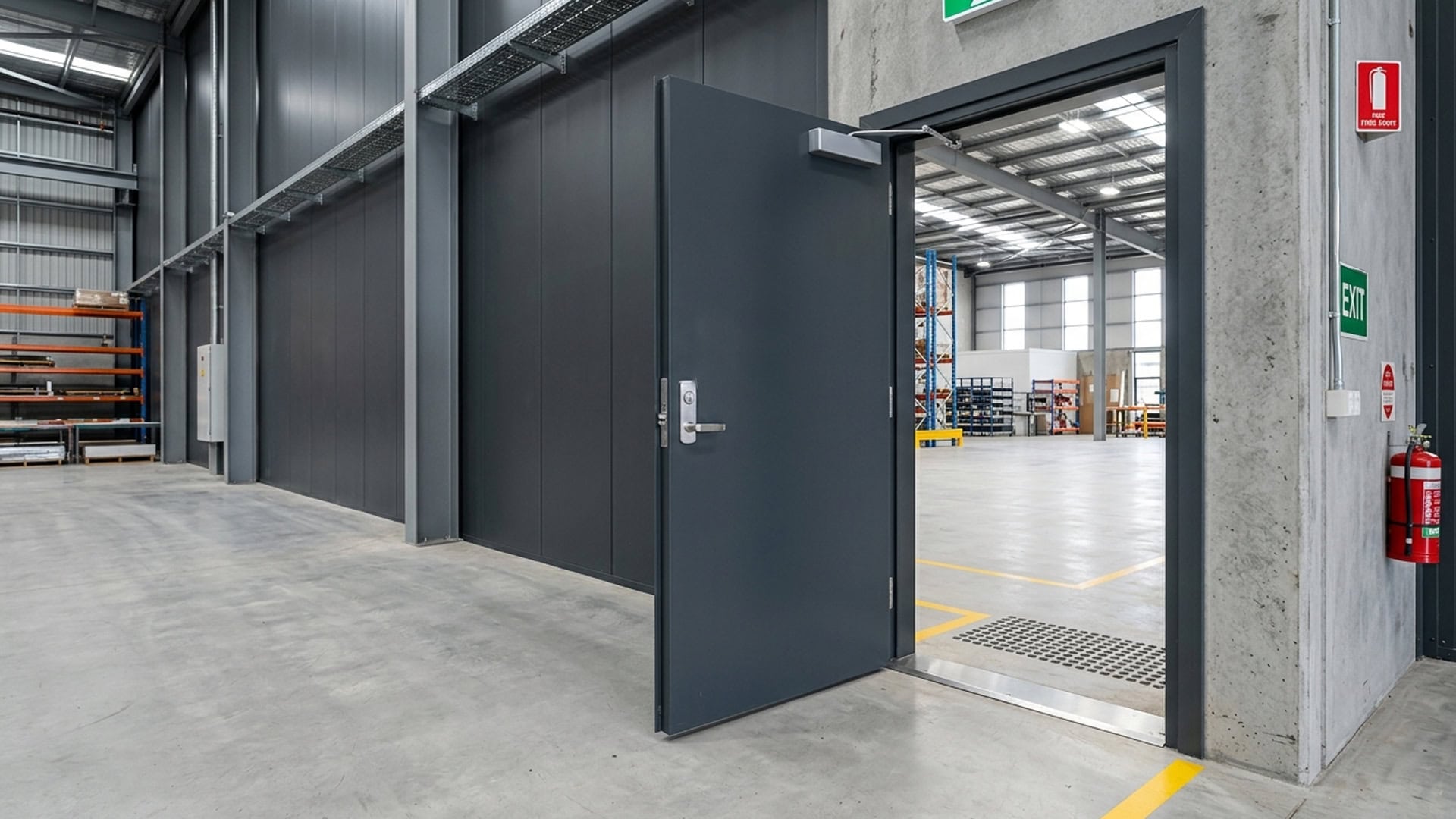

Understanding Accessible Door Requirements for Commercial Buildings
Accessibility is no longer viewed as an optional consideration in Australian building design. Whether you’re developing a warehouse, commercial facility, educational building, healthcare project or public space, understanding DDA door requirements Australia is an important part of creating environments that support accessibility and inclusion.
Doors play a significant role in how people move through buildings. Factors such as opening widths, circulation clearances, hardware selection and door operation can influence whether a doorway is suitable for people using wheelchairs, mobility aids, walking frames or other assistive devices.
This guide explains DDA door requirements, the relationship between the Disability Discrimination Act (DDA), the National Construction Code (NCC) and AS 1428 standards, and practical considerations when selecting doors for commercial projects.
What Are DDA Door Requirements in Australia?
To support accessibility, doors in commercial and public buildings are typically designed in accordance with requirements referenced by the National Construction Code (NCC), which commonly includes provisions from AS 1428 Design for Access and Mobility.
In many applications, accessible doors may include:
- Adequate clear opening widths for wheelchair access
- Sufficient circulation space beside and around doors
- Accessible door handles and hardware
- Appropriate opening forces
- Thresholds designed to minimise trip hazards
- Door configurations that support independent use where practical
The exact requirements vary depending on building classification, location, use, occupancy and overall design.
What Does DDA Compliance Mean?
The Disability Discrimination Act 1992 (DDA) is Australian legislation that aims to prevent discrimination against people with disability. Understanding accessibility obligations often starts with assessing whether existing doors support disability access requirements. Learn more in our guide: Are Your Doors Disability Compliant?
The DDA itself does not provide detailed door dimensions or hardware specifications. Instead, it establishes obligations regarding accessibility and equitable access.
Building designers, architects and certifiers commonly use the NCC and relevant Australian Standards to demonstrate that buildings have been designed to support accessibility outcomes.
When people refer to a “DDA compliant door”, they are generally describing a door system that has been configured to support accessibility requirements referenced through:
- The Disability Discrimination Act (DDA)
- The National Construction Code (NCC)
- AS 1428 Design for Access and Mobility standards
Because compliance depends on the complete doorway system, hardware, clearances and installation, suitability should always be assessed for the specific project.
The Disability Discrimination Act 1992 (DDA) aims to protect people from discrimination and promote equal access to services, facilities and public spaces. Further information about the DDA is available from the Australian Human Rights Commission.
Understanding the Relationship Between DDA, NCC and AS1428
Many building professionals use the terms interchangeably, but each serves a different purpose.
Accessibility requirements form part of a broader regulatory framework for commercial and industrial buildings. Our guide to Door Regulations Australia explains how various standards and regulations can influence door specification decisions.
Disability Discrimination Act (DDA)
The DDA is federal legislation that protects the rights of people with disability and promotes equal access.
National Construction Code (NCC)
The NCC contains technical requirements for building design and construction throughout Australia.
The NCC references accessibility provisions and identifies when accessible paths of travel and accessible entrances are required. The latest NCC resources can be accessed through the Australian Building Codes Board (ABCB).
AS 1428
AS 1428 provides detailed technical guidance relating to accessibility, including:
- Door circulation spaces
- Wheelchair maneuvering clearances
- Reach ranges
- Hardware positioning
- Accessible paths of travel
Together, these documents help project teams design doorways that support accessibility objectives.
For a detailed explanation of accessible widths, read AS1428.1 Door Width Requirements.
Accessible Door Width Requirements
One of the most commonly searched questions is:
What Is the Minimum Door Width Under DDA Requirements?
The answer depends on the building application and the required accessible path of travel.
In many commercial applications, accessible doorways are designed to provide a minimum clear opening width suitable for wheelchair users.
The key term is clear opening width, which differs from the nominal door leaf size.
For example:
| Door Leaf Size | Typical Clear Opening |
|---|---|
| 820mm | May be insufficient for some accessible applications |
| 920mm | Common choice for commercial accessibility |
| 1020mm | Can provide greater user comfort and maneuverability |
Actual clear openings depend on:
- Door frame design
- Door thickness
- Hardware configuration
- Opening angle
- Installation method
For more information on standard commercial sizing, see Commercial Door Sizes Australia.
Door Clearance Requirements
Door width alone does not determine accessibility.
A doorway may have an adequate opening width but still present challenges if there is insufficient maneuvering space.
Why Clearance Matters
Wheelchair users often require space to:
- Approach the doorway
- Reach hardware
- Open the door
- Pass through safely
- Close the door after entry
AS 1428 provides guidance for circulation spaces around doors to support these movements.
Clearance requirements can vary depending on:
- Direction of travel
- Push side or pull side operation
- Corridor width
- Door location
- Door swing
Insufficient clearance is one of the most common causes of accessibility issues in otherwise compliant-looking door installations.
Door Hardware Requirements
Door hardware can significantly affect accessibility outcomes.
Accessible Door Handles
Lever handles are commonly specified because they may be easier to operate than round knobs for users with limited grip strength or dexterity.
Hardware should be positioned within accessible reach ranges and designed to support practical operation.
Common accessible hardware options include:
- Lever handles
- Pull handles
- D-pull handles
- Push plates
- Panic hardware (where appropriate)
- Automatic door activation systems
Locking Systems
Locksets can often be configured to support accessibility objectives depending on:
- User group
- Building function
- Security requirements
- Emergency egress requirements
The suitability of a locking system should be evaluated within the broader door design.
Door Opening Force Considerations
Even a correctly sized doorway can create difficulties if excessive force is required to open it.
Door operation may be influenced by:
- Door size
- Door weight
- Closers
- Seals
- Wind conditions
- Building pressure differences
Where appropriate, designers may consider:
- Adjustable door closers
- Automatic doors
- Assisted opening systems
- Optimised hardware configurations
The goal is to support ease of operation while maintaining the performance requirements of the doorway.
Threshold Requirements
Threshold design is another important consideration.
Raised thresholds can create challenges for:
- Wheelchair users
- Walking frame users
- Mobility scooter users
- People with visual impairments
Accessible doorway designs often aim to minimise abrupt level changes while balancing weather protection and operational requirements.
The suitability of a threshold arrangement depends on the overall project requirements and doorway configuration.
Practical Examples of Accessible Door Design
Warehouse Office Entry
A warehouse office may incorporate:
- Wider doorway openings
- Lever handle hardware
- Appropriate circulation clearances
- Accessible path connections
This configuration can support staff, visitors and contractors with varying mobility requirements.
Commercial Facility Entrance
A commercial building entrance may include:
- Automatic opening systems
- Accessible hardware
- Appropriate threshold detailing
- Adequate maneuvering space
These features can improve accessibility and user experience.
Education Buildings
Schools and training facilities often require accessible pathways between classrooms, administration areas, and amenities.
Door selections may be configured to support these accessibility objectives while addressing durability and operational requirements.
Common DDA Compliance Mistakes
Understanding common mistakes can help avoid costly rectification work.
1. Focusing Only on Door Width
A wider door does not automatically create an accessible doorway.
Clearances, hardware and operation must also be considered.
2. Using Inappropriate Hardware
Round knobs may create usability challenges for some occupants.
Accessible hardware selection is often an important part of overall accessibility design.
3. Ignoring Door Closers
Excessive closing force can reduce usability.
Closer settings should be evaluated as part of the final installation.
4. Insufficient Landing Space
A doorway may satisfy opening width requirements but still be difficult to use if surrounding circulation space is restricted.
5. Late Accessibility Reviews
Accessibility considerations are generally easier and more cost-effective to address during the design phase rather than after construction.
Choosing Doors for Accessible Commercial Applications
When selecting doors for commercial projects, accessibility should be considered alongside:
- Building classification
- Traffic volume
- Environmental conditions
- Operational requirements
- Hardware needs
- Security objectives
- Future maintenance requirements
Door systems can often be configured with various hardware, sizes and installation arrangements to support accessibility goals.
The suitability of any solution depends on the final project design and application.
Why Trust Larnec?
Designing accessible buildings requires careful consideration of door widths, clearances and usability. Larnec has extensive experience supplying doors for commercial and industrial projects where accessibility is an important design consideration. This guide helps explain DDA-related requirements alongside the applicable Australian Standards.
How Larnec Supports Accessible Door Projects
Larnec supplies commercial and industrial door solutions for a wide range of Australian projects.
Depending on project requirements, door systems can be configured with:
- Various opening sizes
- Accessible hardware options
- Commercial-grade construction
- Different frame arrangements
- Application-specific configurations
Because accessibility outcomes depend on the complete doorway design, project teams should assess requirements early during specification and design stages.
If you’re planning a commercial, industrial or public building project and want guidance on suitable door options, the Larnec team can help discuss available configurations and project requirements.
Frequently asked questions
A door is typically considered DDA compliant when the complete doorway system supports accessibility requirements referenced through the NCC and relevant standards such as AS 1428. Factors may include width, hardware, circulation space and operation.
The required width depends on the specific application and accessibility provisions that apply to the project. Clear opening width is generally the key measurement rather than the nominal door size.
No. The DDA establishes accessibility obligations but does not provide detailed door dimensions. Technical requirements are generally addressed through the NCC and referenced standards.
Lever handles are commonly used because they may be easier to operate than round knobs. The suitability of hardware depends on the overall project requirements.
Accessibility requirements are commonly assessed using the NCC and relevant parts of AS 1428.
Yes. Depending on the building classification, occupancy and use, accessible paths of travel and accessible entrances may be required.
Automatic doors can support accessibility outcomes in many applications, particularly where high traffic volumes or reduced opening force requirements are desirable.
Project requirements should be reviewed against the NCC, relevant Australian Standards and advice from qualified design or certification professionals.