



%402x.svg)
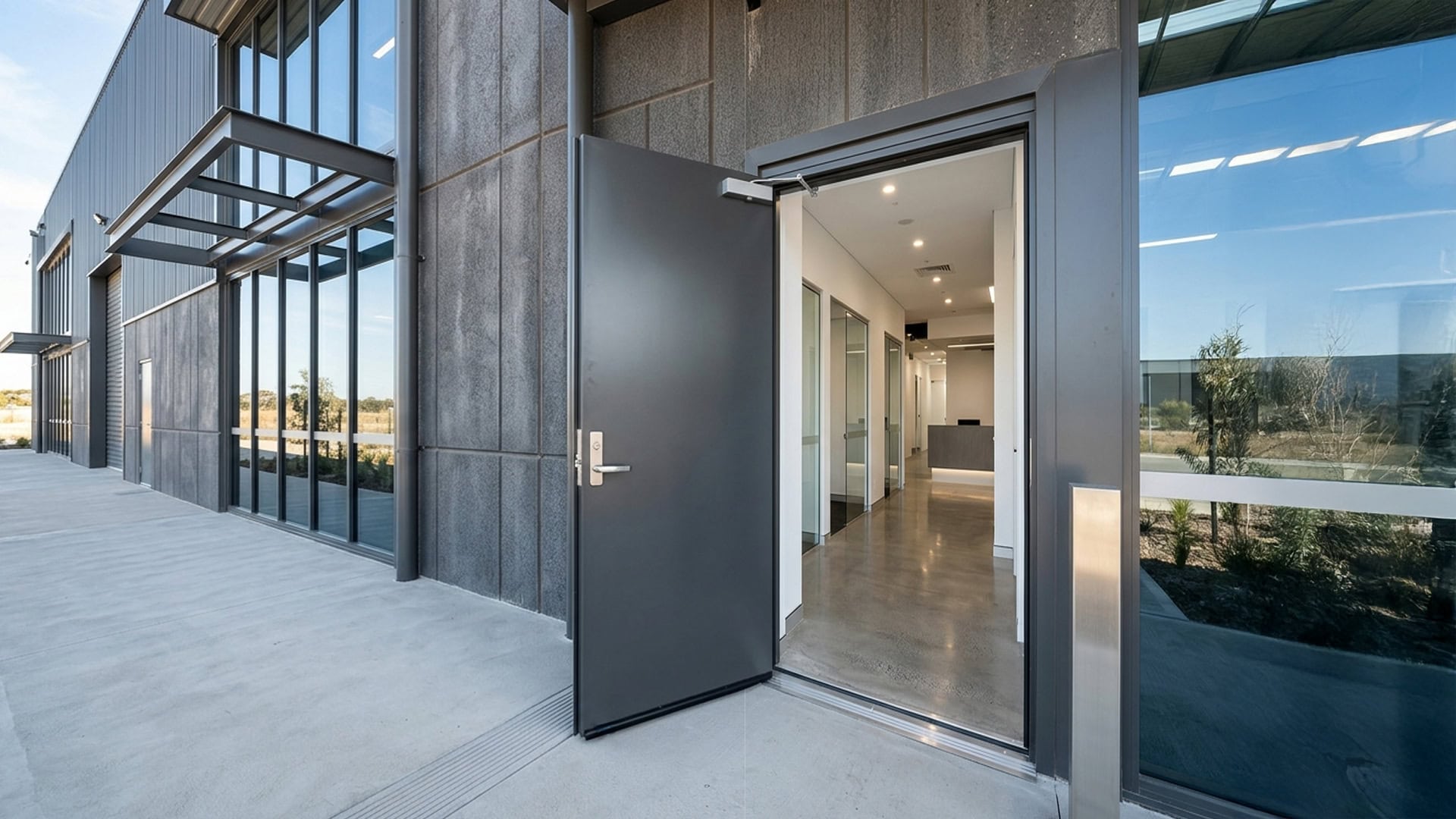

Understanding NCC door width requirements is essential for anyone involved in the design, construction, or management of commercial and industrial buildings. The National Construction Code (NCC) sets minimum requirements for door dimensions, clearances, and accessibility to support safe and functional building access.
What is the minimum door width under the NCC?
For many accessible paths of travel in public and commercial buildings, the door opening generally needs to provide a minimum clear opening of 850 mm when the door is open.
To achieve this, doors are commonly specified as 920 mm wide or larger, depending on the frame, hardware, and door type.
Industrial and warehouse facilities often use wider doors, such as 1020 mm, 1200 mm, or larger, to accommodate equipment, deliveries, and higher traffic volumes.
Final door sizing should be confirmed against the National Construction Code and any relevant accessibility standards, including AS 1428.1.
What Are NCC Door Width Requirements?
The National Construction Code door width requirements specify the minimum dimensions needed for doors in different types of buildings. These requirements are designed to support:
Safe movement of people through a building
Accessibility for wheelchair users and people with mobility limitations
Efficient evacuation during emergencies
Functional access for building operations
Key point
Under the NCC, the critical measurement is often the clear opening width, not just the door leaf size. The clear opening is the usable space available when the door is fully open.
How the NCC and AS1428 Work Together
The NCC references Australian Standards to provide detailed technical guidance. For accessibility, the most relevant standard is AS 1428.1.
The relationship is:
The NCC sets the overall building performance and accessibility requirements.
AS 1428.1 provides the detailed measurements for accessible paths of travel, door clearances, circulation spaces, and hardware positioning.
Designers and builders generally need to consider both documents to achieve a suitable outcome for the specific project.
Example
A 920 mm door leaf may be required to achieve an 850 mm clear opening once the frame, hinges, and door stop are taken into account.
Minimum Door Width Australia: Common Requirements
Door width requirements vary depending on the building classification, the purpose of the door, and whether the door forms part of an accessible path of travel.
| Application | Common Door Size | Typical Clear Opening |
|---|---|---|
| Residential internal doors | 820 mm | ~770–780 mm |
| Residential entry doors | 820–920 mm | ~770–870 mm |
| Commercial accessible doors | 920 mm | ≥850 mm |
| Commercial high-traffic areas | 1020 mm | ~950 mm |
| Industrial and warehouse personnel doors | 920–1020 mm | Varies by configuration |
| Equipment access doors | 1200 mm+ | Project-specific |
These dimensions are typical industry practices. Specific projects may require different sizes based on the NCC, accessibility standards, fire safety requirements, and operational needs.
NCC Door Clearance Requirements
In addition to width, the NCC and AS 1428.1 address door clearances. These clearances help ensure that people can approach, open, and pass through doors safely and comfortably.
Common clearance considerations include:
Space beside the latch side of the door
Clear floor area in front of and behind the door
Door swing direction
Threshold height and floor transitions
Placement of door handles and hardware
Important note
A door may have an adequate width but still be difficult to use if there is insufficient clearance around it. Accessibility assessments generally consider both width and manoeuvring space.
Practical Examples for Commercial Buildings
Main entry door: 1200 mm automatic sliding door
Accessible office doors: 920 mm hinged doors
Meeting room doors: 920 mm doors to support accessibility and furniture movement
Customer entrance: 1500 mm automatic sliding door
Staff-only areas: 920 mm doors
Storage room doors: 1020 mm doors to accommodate stock handling
Patient room doors: often 1020 mm or wider
Corridor doors: designed to support wheelchair and bed movement
Specialist treatment areas: project-specific wider openings
Practical Examples for Industrial Buildings
Standard personnel doors: 920 mm
Doors used by staff carrying equipment: 1020 mm
Emergency exit doors: sized according to occupant load and egress requirements
Operator access doors: 920–1020 mm
Maintenance access doors: wider configurations where tools and equipment must pass through
Forklift access points: typically roller shutters or large industrial openings rather than standard personnel doors
Compliance Considerations
When selecting doors for a commercial or industrial project, consider the following factors:
| Factor | Why It Matters |
|---|---|
| Building classification | Different NCC requirements apply to different building types. |
| Accessible path of travel | Doors on accessible routes generally need larger clear openings. |
| Occupant load | Higher occupant numbers may require wider exits. |
| Door hardware | Handles, closers, and panic hardware can affect usability. |
| Door frame design | Frame thickness influences the final clear opening. |
| Future building use | Wider doors can provide flexibility for changing operational needs. |
Common Mistakes to Avoid
Assuming the door leaf width equals the clear opening
A 920 mm door does not automatically provide a 920 mm clear opening. The frame and door swing reduce the usable width.
Ignoring accessibility requirements
Even if a door appears wide enough, insufficient circulation space or incorrect hardware placement can create accessibility issues.
Choosing the minimum size for all applications
Minimum compliance dimensions may not be the most practical option for high-traffic commercial or industrial environments.
Overlooking door swing impacts
A door that swings into a circulation path can reduce usable space and affect accessibility.
Failing to coordinate with fire and safety requirements
Some doors may need additional features such as fire-rated construction, panic hardware, or smoke seals, which can influence the overall door specification.
Choosing the Right Door Width
For many commercial projects, a 920 mm door is commonly selected because it can help support accessibility objectives while remaining practical for everyday use.
For industrial facilities, wider options such as 1020 mm or 1200 mm may be beneficial where equipment, trolleys, or larger items need to pass through regularly.
The most suitable door width depends on:
The building’s NCC classification
Whether the door is part of an accessible path
Expected traffic volumes
Operational requirements
Future flexibility needs
Why Trust Larnec?
Understanding National Construction Code (NCC) requirements is essential when specifying commercial and industrial doors. Larnec regularly works with construction professionals across Australia and develops technical resources that explain complex building requirements in a practical and easy-to-understand way.
Conclusion
Understanding NCC door width requirements is essential for delivering commercial and industrial buildings that support accessibility, safety, and efficient operation. While the commonly referenced benchmark is an 850 mm clear opening, the most suitable door width depends on the building type, occupancy, traffic levels, and operational needs.
For many commercial applications, 920 mm doors are a practical choice because they can be configured to support accessibility objectives. Industrial facilities may benefit from wider options where equipment movement and higher traffic volumes are expected.
If you’re planning a new project or reviewing an existing facility, it can be helpful to discuss door sizing and configuration options with our experienced door specialists to ensure the solution is appropriate for your application and aligns with relevant NCC and accessibility requirements.
Frequently asked questions
For many accessible paths of travel, the door opening generally needs to provide a minimum clear opening of 850 mm.
In many cases, a 920 mm door can be configured to provide the required clear opening, but the frame, hardware, and installation details must also be considered.
Door width refers to the size of the door leaf, while clear opening width is the usable space available when the door is open.
Not always, but warehouses often benefit from wider doors to accommodate equipment, deliveries, and higher traffic volumes.
AS 1428 provides detailed accessibility measurements, including clear opening widths, circulation spaces, and hardware placement requirements.
They include the clear floor space around the door, latch-side clearance, door swing considerations, and threshold requirements to support accessibility.
Requirements depend on the scope of renovation, change of use, and local authority approvals. A building certifier or compliance professional can provide project-specific advice.
The official requirements are available through the Australian Building Codes Board website and the relevant Australian Standards.