



%402x.svg)
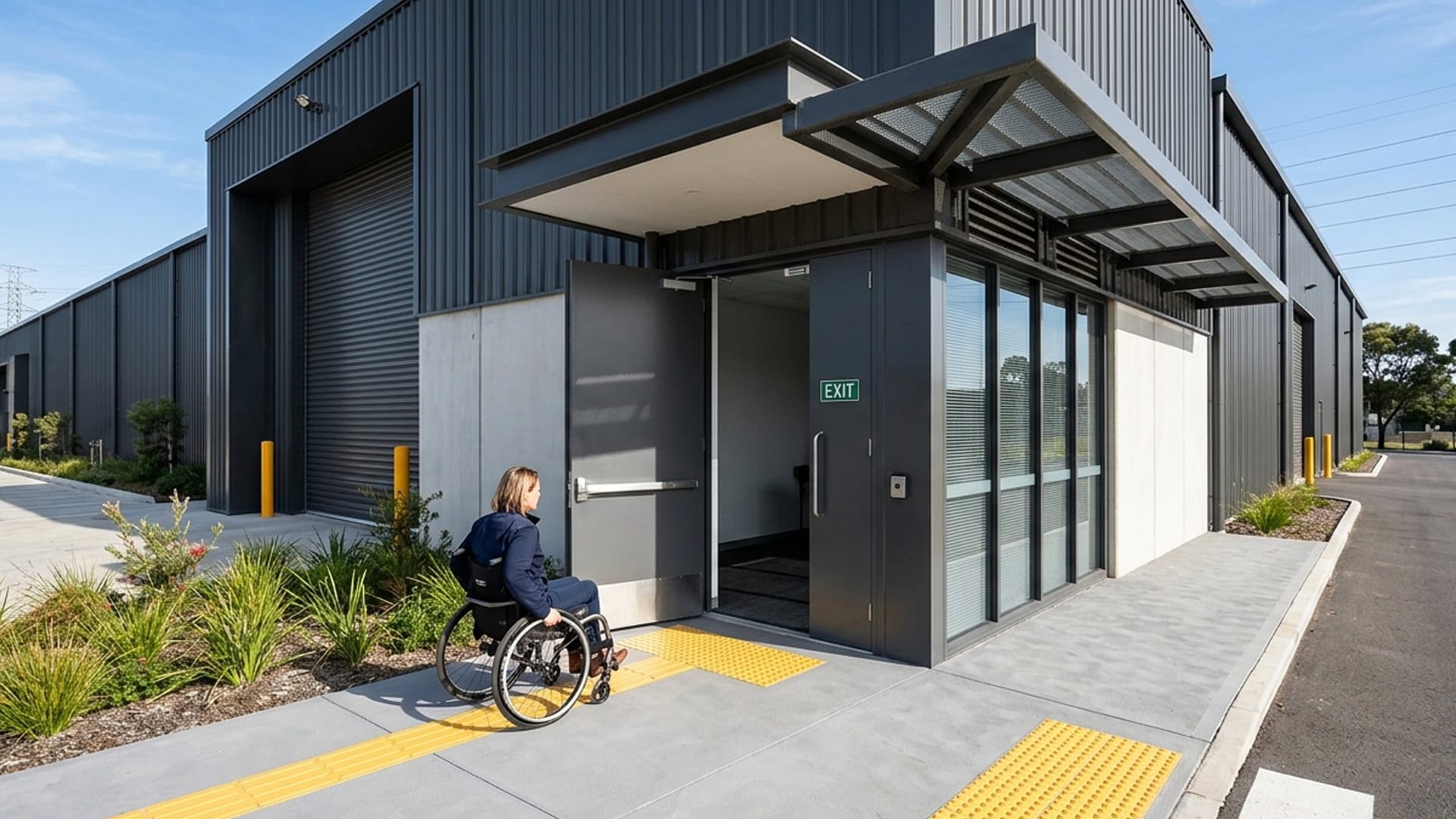

Accessibility is an important consideration in Australian building design, particularly for commercial, industrial, public, and community facilities. Understanding AS1428 door width requirements can help building owners, designers, builders, and facility managers select door configurations that support accessible movement throughout a building.
While accessibility outcomes depend on the overall design, hardware selection, clearances, circulation spaces, and application, door width remains one of the most important factors influencing ease of access for wheelchair users and people with mobility limitations.
This guide explains wheelchair accessible door width requirements, accessibility door dimensions, common accessible door sizes in Australia, and key considerations when selecting doors for accessible environments.
What Are AS1428 Door Width Requirements?
AS 1428 is the Australian Standard that provides guidance for design and access considerations for people with disabilities.
When discussing AS1428 door width requirements, the focus is generally on achieving sufficient clear opening width to support wheelchair access and ease of movement through doorways.
The standard typically references clear opening dimensions rather than simply the nominal door leaf size. This means the actual usable opening space is often more important than the door panel width itself.
Factors that may influence the final accessible opening include:
- Door leaf width
- Door frame configuration
- Hinge type
- Door hardware placement
- Door stop projections
- Wall construction
- Opening direction
Because of these variables, accessibility outcomes are generally assessed based on the complete doorway system rather than the door leaf alone.
What Is the Minimum Door Width for Wheelchair Access?
One of the most common questions is:
What is the minimum door width for wheelchair access?
In many accessibility applications, a doorway may be designed to provide a clear opening that supports wheelchair passage and maneuverability.
The required opening can vary depending on:
- Building classification
- Intended use
- Access path design
- Circulation space availability
- Door hardware configuration
- Applicable building requirements
As a result, selecting a wider door leaf can often provide greater flexibility when designing for accessibility objectives.
Many projects choose door widths that can help achieve the necessary clear opening dimensions once hardware and framing components are considered.
Understanding Clear Opening Width vs Door Size
A common misconception is that door width and clear opening width are the same thing.
They are not.
For example:
- An 820mm door leaf does not necessarily provide an 820mm clear opening.
- A 920mm door leaf may provide a different clear opening depending on hardware and frame design.
- Wider door options can assist in achieving accessible circulation requirements.
This distinction is important when assessing AS1428 compliant door size options.
Design teams typically evaluate the complete opening rather than relying solely on nominal door dimensions.
Accessible Door Sizes Australia
Several door sizes are commonly specified for accessibility-focused projects across Australia.
Common accessible door sizes Australia may include:
| Door Leaf Width | Typical Applications |
|---|---|
| 820mm | Some commercial and office environments |
| 870mm | Accessibility-focused fit-outs |
| 920mm | Common accessible commercial applications |
| 1020mm | Higher traffic and improved manoeuvrability |
| 1100mm | Industrial and specialised access requirements |
The suitability of each size depends on the overall doorway configuration and project requirements.
Wider door options can provide additional clearance and may support easier movement for wheelchair users, mobility aids, equipment trolleys, and high-traffic environments.
Accessibility Door Dimensions Beyond Width
While width receives most attention, accessibility door dimensions involve several factors.
These may include:
Door Height
Most commercial and accessibility-focused doors are commonly manufactured at 2040mm high, although alternative heights are available for specific applications.
Circulation Space
Approach clearances around the doorway often influence accessibility outcomes.
Available wall space, corridor width, and turning areas may affect usability.
Door Hardware
Lever handles are frequently specified because they can be easier to operate than traditional knob sets.
Opening Forces
The force required to open and close a door can also influence accessibility performance.
Threshold Design
Thresholds and floor transitions may affect wheelchair movement and accessibility outcomes.
Because accessibility is influenced by multiple elements, door size should be assessed alongside the broader doorway design.
AS1428 Compliant Door Size Considerations
When evaluating AS1428 compliant door size options, project teams often consider:
- Intended building use
- Occupant requirements
- Traffic levels
- Accessibility objectives
- Available wall space
- Door hardware selection
- Future flexibility
Larger door sizes can offer additional design flexibility and may assist in supporting accessibility goals where greater clearance is beneficial.
However, final suitability always depends on the complete installation and project-specific requirements.
Disability Access Door Requirements in Commercial Buildings
Many commercial projects incorporate disability access door requirements as part of broader accessibility planning.
Examples may include:
- Office buildings
- Educational facilities
- Healthcare environments
- Retail centres
- Warehouses
- Government buildings
- Community facilities
- Industrial workplaces
In these environments, wider door configurations are often selected to support ease of movement for occupants and visitors.
Accessibility considerations are frequently integrated during early project planning to help reduce redesign costs later in the construction process.
Relationship Between AS1428 and Building Regulations
Accessibility requirements are often considered alongside broader building regulations and project specifications.
Door width is only one component of an accessible path of travel.
Other factors may include:
- Corridor dimensions
- Ramp design
- Door hardware
- Signage
- Circulation spaces
- Entry thresholds
- Building classification
Understanding how these elements work together can help create more functional and accessible environments.
For a broader overview of Australian requirements, see our guide to Door Regulations Australia.
Choosing the Right Accessible Door Size
Selecting the right door size involves balancing accessibility objectives, building constraints, traffic requirements, and future usability.
Many projects choose wider door configurations because they can:
- Improve ease of movement
- Support wheelchair access
- Assist with equipment transport
- Enhance user comfort
- Provide greater operational flexibility
The most appropriate solution will depend on the specific application, building design, and project requirements.
Consulting with building designers, certifiers, architects, and door specialists during planning can help identify suitable options for the intended environment.
Why Trust Larnec?
Accessibility is an important consideration when selecting commercial and industrial doors. Larnec works with builders, designers and contractors across Australia to provide door solutions suitable for projects requiring compliance with accessibility requirements. This article references AS 1428.1 and related Australian building requirements to help explain compliant door width provisions.
Related Accessibility and Door Sizing Resources
Meeting Australian accessibility requirements involves more than simply providing a wider doorway. Door widths, clear openings, circulation spaces and broader building regulations all contribute to creating safe and accessible commercial environments. The following guides provide additional information to help you understand accessibility requirements and related compliance topics:
- DDA Door Requirements Australia – Learn about disability access requirements for commercial doors and how they help create accessible buildings.
- Commercial Door Sizes Australia – Discover standard commercial door sizes and understand how door dimensions can support accessibility and building compliance.
Finding the Right Accessibility Door Solution
Every project has unique accessibility objectives, operational requirements, and building constraints. Door size is only one part of creating a functional and accessible entrance solution.
If you’re assessing accessible door options for a commercial, industrial, warehouse, or public building project, Larnec can help you explore door configurations designed to support accessibility considerations while meeting the needs of your application.
Frequently asked questions
AS1428 focuses on accessible design considerations, including doorway clearances that can support wheelchair access and ease of movement. Requirements are generally assessed based on clear opening width rather than nominal door size.
The required opening can vary depending on building design, application, and accessibility objectives. Clear opening dimensions are typically more important than the door leaf size itself.
Many projects use 920mm, 1020mm, or wider door configurations where increased clearance and manoeuvrability are beneficial.
Suitability depends on the complete doorway configuration, clear opening achieved, hardware selection, and project-specific requirements.
Wider doors can provide additional clearance and may improve ease of movement for wheelchair users, mobility aids, equipment, and high-traffic environments.