

%402x.svg)
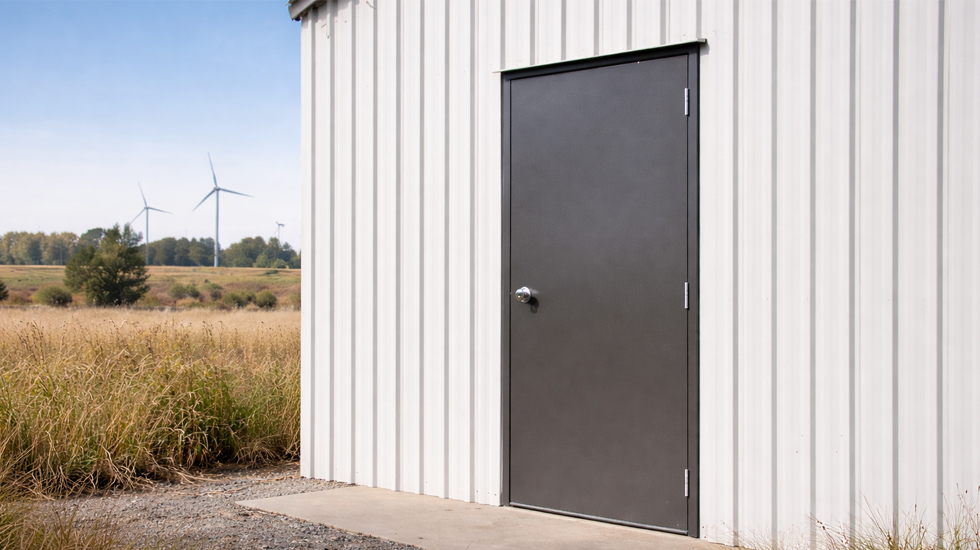

When specifying doors for sheds, garages, and industrial buildings, it may be a common assumption that all doors are treated the same. In reality, personal access (PA) doors are assessed differently under Australian engineering and National Construction Code (NCC) requirements.
So, do personal access doors in sheds need to be wind rated? In most engineered sheds, the answer is yes. Here’s why.
Why personal access doors are treated differently
A PA door is a rigid, framed opening in a building. Unlike flexible cladding or roller doors, a hinged PA door needs to resist wind pressure and transfer loads safely into the surrounding wall structure.
This makes a PA door a structural element, not just an access feature. For this reason, PA doors are typically required to:
- Include a door and frame designed to handle wind loads
- Be installed in a way that maintains the building’s overall structural performance
When a wind-rated PA door is required
In practice, a wind-rated personal access door is required whenever the shed:
- Requires engineering or building approval
- Is located in a designated Australian wind region (A-D)
- Has engineering drawings that specify minimum wind performance
- Is used for commercial, industrial or agricultural purposes
These cover most typical shed projects across Australia.
What happens if you install a PA door that doesn’t meet the required wind rating?
Installing a non-wind-rated PA door can possibly lead to delayed or refused engineering sign-off, certification issues, requests for door replacement after installation, and of course, risk of failure and possible safety issues.
Choosing a compliant PA door from Larnec
At Larnec, Sentry personal access doors are tested and approved for use in Australian wind regions A-D (model dependent) and engineered specifically for shed, garage and industrial applications – removing uncertainty during approval and construction.
Need Help Choosing the Right Wind-Rated PA Door?
If you’re planning a shed, garage, or industrial project and want to make sure your personal access doors meet NCC requirements, our team at Larnec can guide you. Contact us today to discuss compliant PA doors for your site, get expert advice on engineering approvals, or ensure a smooth construction process.