
%402x.svg)
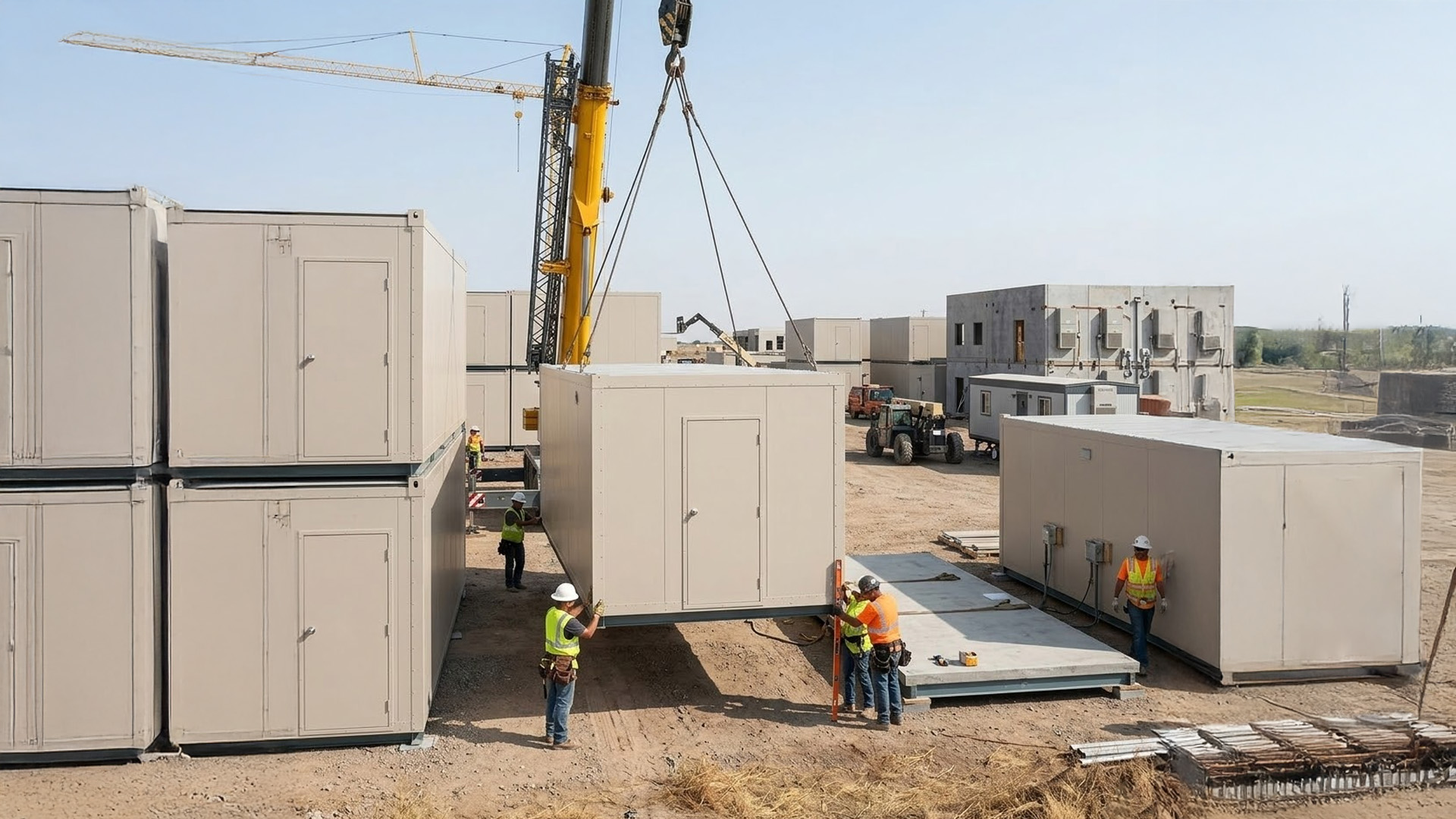

Modular and portable construction continues to expand across Australia — from site offices and accommodation units to data centres and mission-critical facilities.
While speed, efficiency and repeatability are central to modular builds, the performance of the door system is often underestimated. In transportable construction, doors don’t just close an opening — they must support structural movement, installation efficiency, safety objectives and long-term durability.
Here’s what to consider when specifying doors for modular and portable buildings.
1. Transport & Handling: Built to Withstand Movement
Unlike traditional builds, modular structures are:
- Manufactured off-site
- Transported by truck
- Craned into position
- Sometimes relocated more than once
This introduces vibration, racking forces, and structural flex during transit.
Door systems suited to modular construction are typically:
- Pre-hung for structural consistency
- Fully framed (often 4-sided jamb systems)
- Designed to support repeated opening cycles
- Able to be configured with hardware that reduces loosening during transport
The suitability of a door for modular buildings will depend on frame construction, fixing method and hardware selection — all of which should align with the wall system and project conditions.
2. Structural Compatibility with Modular Wall Systems
Modular buildings often use:
- Steel-framed wall systems
- Lightweight composite panels
- Insulated sandwich panels
- Concrete tilt panels (in larger modular formats)
Not all door frames integrate seamlessly into these systems.
Doors intended for modular applications are commonly:
- Designed to suit steel-framed or panelised walls
- Configurable for different wall thicknesses
- Pre-prepared for specific fixing methods
- Manufactured to reduce on-site modification
Selecting the right frame profile and fixing method can reduce installation adjustments and help maintain structural integrity of the module.
3. Fire-Rated Door Considerations
Fire separation requirements in modular construction can vary depending on:
- Building classification
- Use (accommodation, plant room, data facility, etc.)
- State/Territory regulations
- Wall system construction
Where fire-rated openings are required, the door leaf, frame and hardware configuration must be specified accordingly.
For modular projects, it is important that:
- Fire-rated options are compatible with the wall system
- Certification aligns with the intended application
- Hardware selections support the required fire rating
Larnec offers fire door solutions that can be configured to suit modular and portable applications, subject to the required rating and project specifications.
Final performance outcomes depend on the door type, rating, hardware selection and installation method.
4. Thermal Performance & Insulation Options
Portable and modular buildings are frequently used in:
- Remote locations
- Harsh climates
- Temporary accommodation
- Climate-controlled environments
Door core selection can influence insulation performance.
Depending on the project requirements, door systems may be configured with:
- Expanded polystyrene (EPS) cores
- Polyisocyanurate (PIR) cores
- Solid or reinforced constructions
The appropriate core will depend on thermal objectives, structural needs and environmental exposure. Early coordination during specification helps ensure alignment with the broader building envelope strategy.
5. Durability in High-Use & Industrial Settings
Many modular structures are deployed in demanding environments such as:
- Mining camps
- Construction sites
- Infrastructure projects
- Data centres
- Equipment rooms
In these settings, door systems are expected to support frequent operation and exposure to external elements.
Suitable modular-ready door systems often include:
- Fully metal-clad construction
- Zinc-plated or corrosion-resistant hinge options
- Hardware that can be selected to suit traffic levels
- Powder-coated finishes compatible with external exposure
Long-term suitability depends on configuration, hardware selection, and the specific environmental conditions of the project.
6. Installation Efficiency & Repeatability
One of the advantages of modular construction is repeatability.
Pre-hung door systems can:
- Reduce on-site installation time
- Support consistent alignment
- Minimise post-installation adjustment
- Assist with quality control during factory assembly
For manufacturers of modular buildings, selecting door systems designed to integrate into production workflows can improve efficiency across multiple builds.
7. Security & Access Control Flexibility
Security requirements in modular buildings vary widely.
A site office may require basic controlled access, while a data centre or mission-critical facility may require more advanced hardware configurations.
Door systems used in modular construction can be configured with:
- Lever or knob locksets
- Access control preparation
- Door closers
- Escape function hardware
Final performance depends on the selected hardware and integration with the overall access strategy.
Larnec’s Experience in the Modular Sector
Larnec is undertaking increasing work within the modular and portable building sector across Australia, including:
- Site and transportable buildings
- Data centres
- Mission-critical facilities
Our door systems are designed to support modular construction methodologies, with pre-hung configurations, fire-rated variants and core selections suited to different environments.
Suitability for any specific project will depend on:
- Wall system type
- Required rating (if applicable)
- Environmental exposure
- Hardware configuration
- Installation method
We work alongside builders and modular manufacturers to align door specifications with project requirements rather than applying a one-size-fits-all approach.
Final Thoughts: Specification Matters in Modular Construction
In modular and portable buildings, the door is not an afterthought — it is a structural, safety and operational component of the building system.
When specifying doors for modular construction, it is important to consider:
- Transport resilience
- Wall compatibility
- Fire rating (if required)
- Insulation objectives
- Hardware configuration
- Installation workflow
Early coordination during design can reduce rework, delays and performance concerns later in the project lifecycle.
If you’re working on a modular or portable building project and would like to explore suitable door configurations, Larnec can assist with product options aligned to your application requirements.