
%402x.svg)

When selecting an insulated industrial door, the core material plays an important role in thermal performance, rigidity and overall suitability for the application.
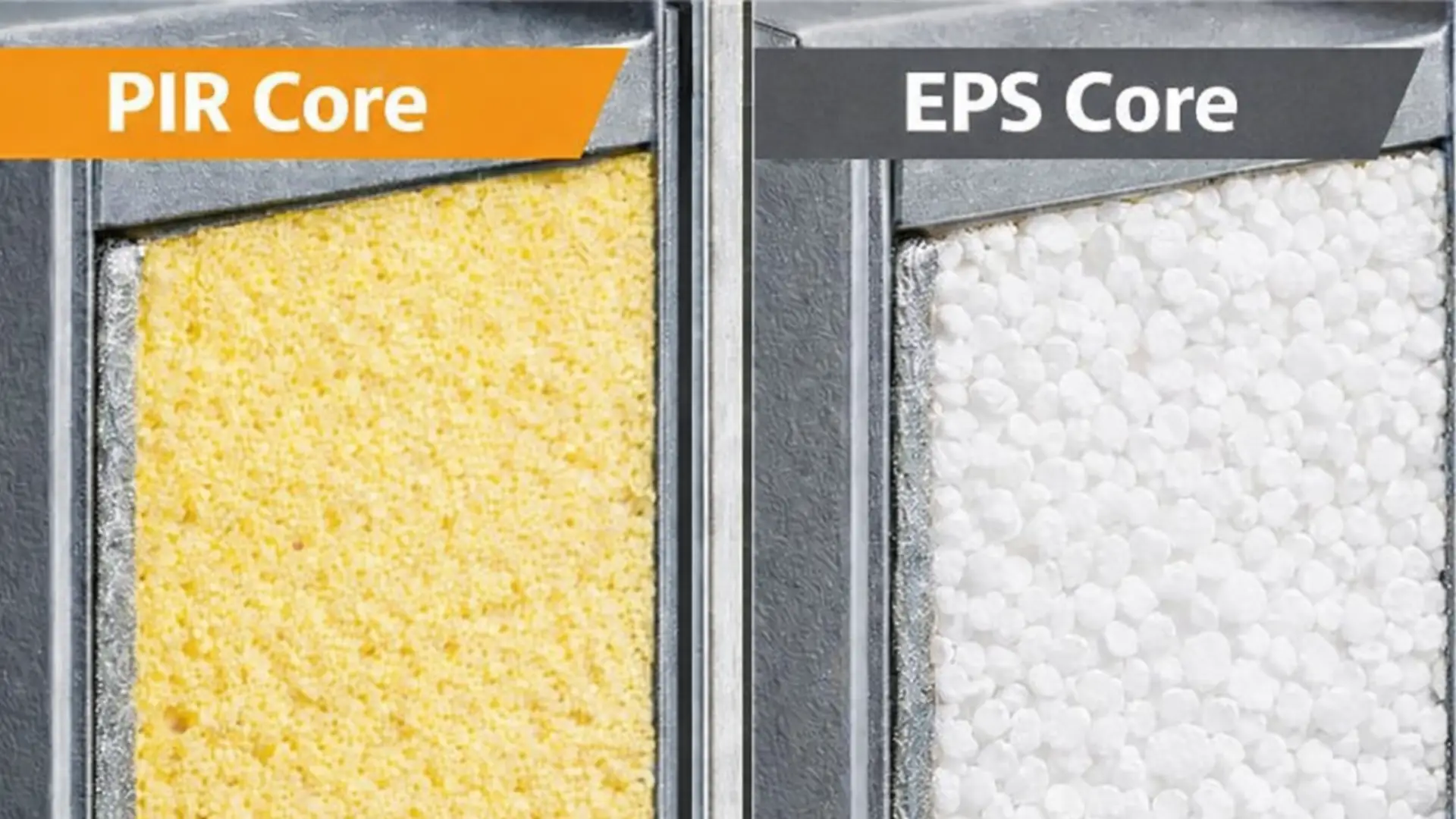
Two common insulation options used in metal-clad doors are PIR (Polyisocyanurate) and EPS (Expanded Polystyrene). Both are widely used across commercial and industrial construction — but they are designed to support different performance priorities.
At Larnec, our industrial personal access doors are available with either EPS or PIR core options, allowing you to select the configuration that best suits your project.
What Is EPS Core?
EPS (Expanded Polystyrene) is a lightweight, closed-cell foam insulation commonly used in construction panels and insulated doors.
Key Characteristics of EPS
- Lightweight insulation material
- Provides consistent thermal resistance
- Cost-effective insulation option
- Suitable for general-purpose applications
- Designed to support everyday temperature control
EPS cores are commonly selected for sheds, garages, storage facilities and industrial buildings where moderate insulation performance is appropriate.
For many standard industrial environments, EPS offers a reliable balance of insulation and practicality without adding unnecessary cost.
What Is PIR Core?
PIR (Polyisocyanurate) is a rigid thermoset insulation foam engineered to provide higher thermal performance compared to standard polystyrene insulation options.
Key Characteristics of PIR
- Higher thermal resistance relative to EPS at similar thickness
- Increased rigidity within the door structure
- Designed to support improved temperature stability
- Suitable for projects where energy efficiency is a priority
PIR cores are often considered for commercial and industrial applications where internal climate control, thermal efficiency or structural rigidity are more important factors.
PIR vs EPS: Key Differences
| Feature | EPS Core | PIR Core |
|---|---|---|
| Thermal Performance | Designed for reliable everyday insulation | Can provide higher insulation values per thickness |
| Rigidity | Lightweight and stable | Increased structural rigidity |
| Cost Consideration | Generally more economical | Typically a premium upgrade |
| Ideal Use | Sheds, garages, standard industrial builds | Temperature-controlled or higher-spec builds |
It’s important to note that overall door performance depends not only on the insulation core, but also on:
- Door thickness
- Sealing systems
- Installation quality
- Hardware configuration
- Application environment
The core is one component within a complete door system.
When to Choose EPS Core
EPS may be suitable when:
- The building is not fully climate controlled
- The primary goal is durable, practical access
- Budget sensitivity is a consideration
- Standard thermal performance is sufficient
For many Australian industrial sheds and warehouses, EPS can provide dependable insulation aligned with everyday operational needs.
When to Choose PIR Core
PIR may be worth considering when:
- The building requires stronger temperature control
- Energy efficiency is a project priority
- Greater panel rigidity is preferred
- The door is part of a higher-spec commercial build
Because PIR typically delivers higher thermal resistance at comparable thickness, it can be configured to support projects aiming for improved energy performance.
How This Applies to Larnec Doors
Larnec’s Sentry 200 Series industrial personal access doors are available with:
- EPS core – Standard option for reliable thermal insulation and everyday performance
- PIR core – Upgrade option for enhanced insulation and increased rigidity
Both configurations are:
- Pre-hung for straightforward installation
- Dual-skin, fully metal-clad construction
- Made in Australia
- Designed for industrial sheds, warehouses, garages and modular structures
The choice between EPS and PIR ultimately depends on your project requirements, building use and performance expectations.
Final Thoughts: Which Core Is Right for You?
There isn’t a one-size-fits-all answer.
Both EPS and PIR cores are designed to support different priorities — whether that’s cost-efficiency, everyday durability, or enhanced thermal performance.
If you’re unsure which configuration best suits your shed, warehouse, modular building or commercial project, our team can help you compare options based on:
- Building type
- Location and climate
- Desired thermal performance
- Budget considerations
Call Larnec on 1800 527 632 to discuss the most suitable core option for your application.
Selecting the right door core isn’t about choosing the “best” option — it’s about choosing the option that aligns with your project’s needs.