



%402x.svg)
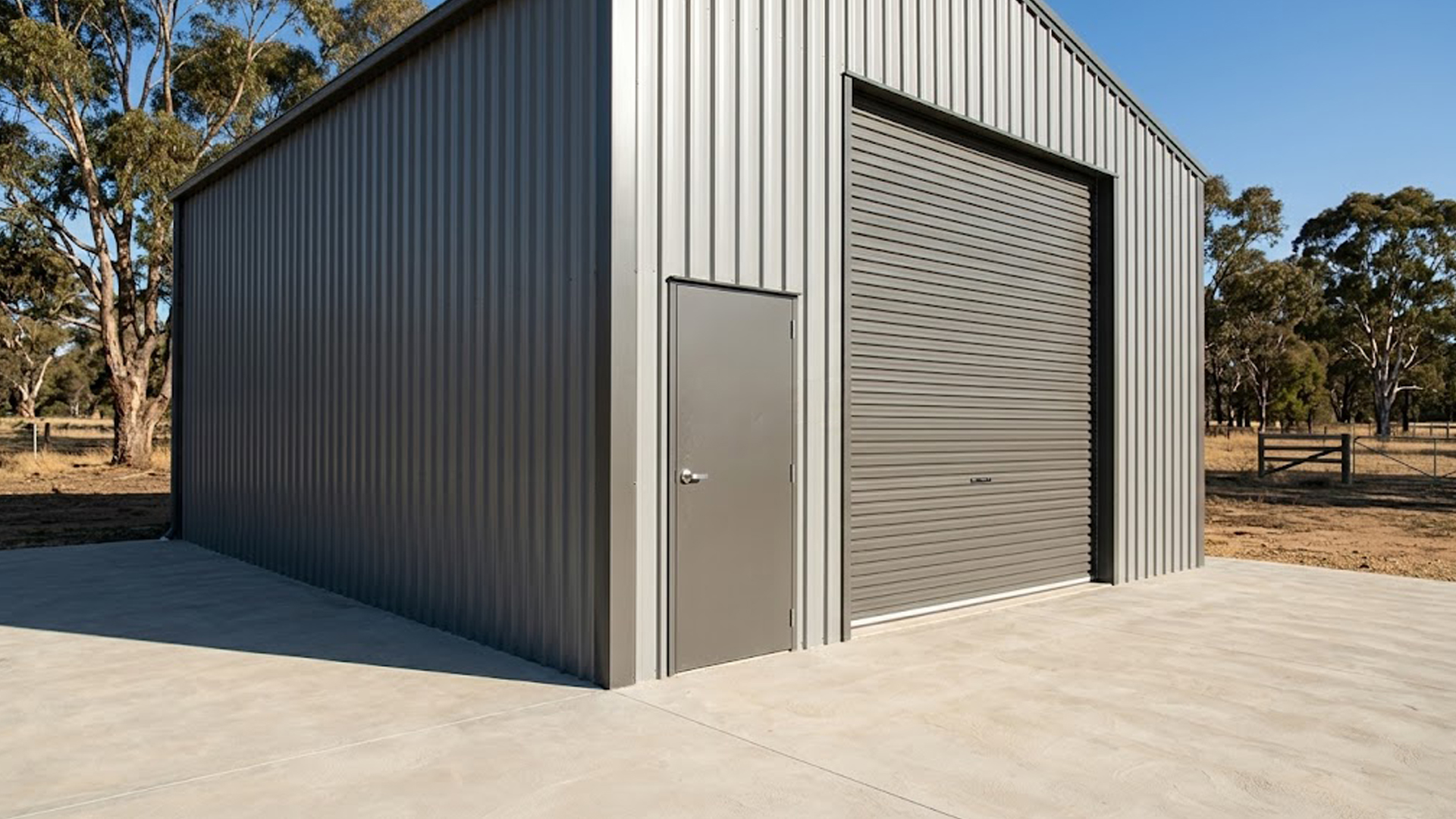

Spend enough time around the shed and garage industry and you’ll start to hear a term pop up:
“Coffin sheds.”
It’s not official. It’s not in any code. But it’s becoming more common—and for good reason.
These are sheds or garages built with only a roller door and no personal access (P.A) door. No secondary exit. No easy way in or out unless that main door is open and operational.
And while it might seem like a cost-saving shortcut, it can create real risks—particularly in an emergency.
The Problem with a Single Roller Door
Roller doors are designed for vehicle access. They’re not designed as your primary means of escape.
Think about real-world scenarios:
- A power failure mid-operation
- A mechanical fault or jammed roller door
- A vehicle parked inside, blocking access
- A fire event, where heat, smoke, or structural movement compromises the door
In each case, your only exit can quickly become unusable.
The National Construction Code is clear on one overarching principle:
Buildings should provide safe means of egress so occupants can evacuate without injury during an emergency.
While most domestic sheds (Class 10a buildings) don’t have the same strict exit requirements as commercial buildings, the intent around safe evacuation still underpins all building design.
This is where “coffin sheds” fall short.
Why More Installers Are Pushing Back
We’re hearing it more and more from shed builders and installers:
“We won’t recommend a shed without a personal access door anymore.”
This shift isn’t being driven by legislation, yet. It’s being driven by experience.
Installers are seeing:
- Near-miss situations where roller doors failed
- Clients frustrated by poor day-to-day usability
- Increased awareness of safety expectations
There’s a growing understanding that a shed isn’t just a storage box—it’s a functional space that people occupy.
And once you treat it that way, a second point of access stops being optional.
It’s Not Just About Emergencies
Even outside of worst-case scenarios, relying on a roller door alone is inconvenient at best.
A personal access door gives you:
- Quick, everyday access without opening the entire shed
- Better workflow and movement in and out
- Improved security control (especially when upgraded with anti-burglary hardware)
- Reduced wear on your main roller door
It turns your shed from a “big box” into something that actually works with how you use it.
Compliance Is Evolving (Even If It’s Not Mandatory Yet)
Right now, most residential sheds fall under Class 10a non-habitable buildings, which means fewer prescriptive requirements compared to homes or commercial buildings .
That’s why you can still legally build a shed with only a roller door.
But here’s what is changing:
- Greater emphasis on engineering compliance (e.g. wind-rated doors as structural elements)
- Increased scrutiny from certifiers on overall building performance and safety
- Broader industry alignment with accessibility and usability standards (e.g. doorway widths, pathways)
In other words, the direction is clear—even if the rules haven’t fully caught up.
Adding a personal access door is increasingly seen as best practice, not an upgrade.
Smart builders and property owners aren’t waiting for legislation to force the change.
They’re getting ahead of it.
Take It a Step Further: Keyless Entry with Digital Locks
Once you’ve added a personal access door, there’s an opportunity to make it even more functional.
Keyless entry with a digital lock is becoming an increasingly popular upgrade—especially for sheds and garages that are used regularly.
Instead of relying on keys, you can access your shed via:
- PIN code entry
- Keypad access (ideal for shared use)
- Optional smart features depending on the setup
This solves a few common frustrations:
- No more lost or forgotten keys
- Easy access for multiple users (family, staff, contractors)
- Better control over who can enter and when
- Clean, modern functionality that suits how people actually use their space
From a security perspective, digital locks can also be paired with anti-burglary hardware, giving you both convenience and confidence in one solution.
And for high-use environments like workshops, storage sheds, or commercial spaces—it’s often a smarter, more efficient way to manage access day-to-day.
A Better Way to Build
At Larnec, we design personal access doors specifically for sheds, garages and industrial buildings.
That means:
- Engineered to integrate with your structure
- Designed for reliable, everyday use
- Upgradeable with anti-burglary hardware for added security
- Options available to meet wind rating and compliance requirements
- Fire-rated options available where needed (without overcomplicating your build)
Most importantly, they solve the core issue:
They give you a safe, dependable way in—and out.
Talk to Larnec About Your Project
You can build a shed with just a roller door. But the better question is:
Should you?
When you consider safety, usability, and long-term value, a personal access door isn’t an add-on—it’s a fundamental part of a well-designed structure.
And as the industry continues to evolve, those “coffin sheds” will become exactly that—a thing of the past.
If you’re planning a new shed, garage or industrial building, contact our team to discuss the right personal access door solution for your project. We can help you choose a door that delivers everyday practicality, improved safety and long-term performance.
Frequently asked questions
While it may be legally permitted for many residential sheds, relying on a roller door alone can create access and safety concerns. If the roller door fails, jams, or is blocked, occupants may have no easy way to exit. Adding a personal access door provides a safer and more practical secondary point of access.
A personal access door improves everyday usability by allowing quick entry and exit without opening the main roller door. It can also improve safety in emergencies, reduce wear on the roller door, and provide better security options through upgraded locking hardware.
For many residential sheds classified as Class 10a buildings, a personal access door may not be mandatory. However, safe access, usability, and building performance are increasingly important considerations, and many builders now view personal access doors as best practice.
Yes. Wind-rated personal access doors are available and can be engineered to meet structural and regional wind-loading requirements. This is particularly important in cyclone-prone and high-wind areas across Australia.
The best door depends on your building type, location, and use case. Steel personal access doors are a popular choice because they offer durability, security, weather resistance, and can be upgraded with anti-burglary hardware, fire-rating, or wind-rating where required.
Yes. A properly specified personal access door with quality locking hardware can improve controlled access while reducing the need to frequently open the main roller door. This can make the shed more secure and more convenient to use day-to-day.