



%402x.svg)
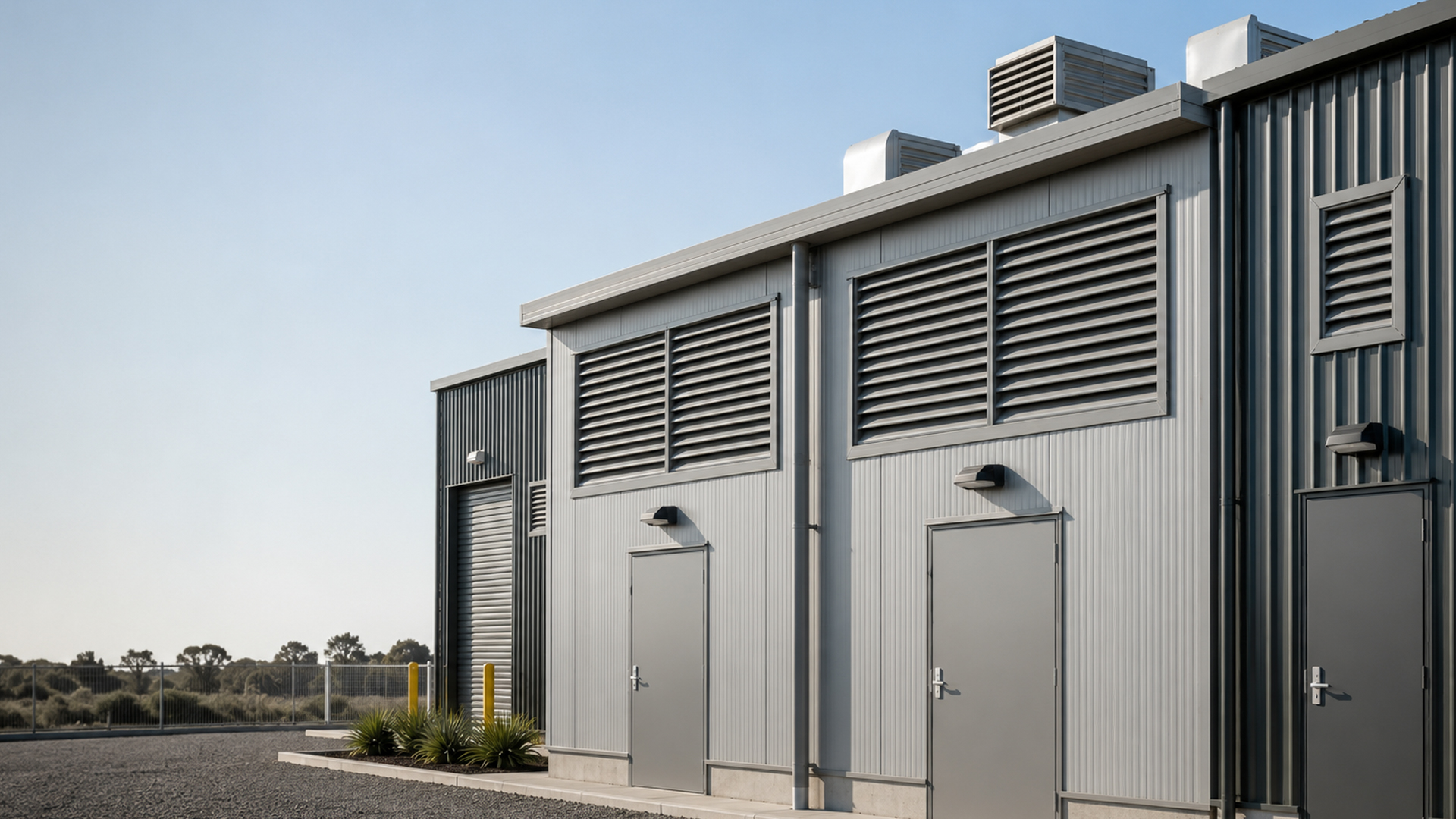

Ventilation plays an important role in the performance and efficiency of many industrial, modular, commercial, and infrastructure buildings. Whether the goal is improving airflow, reducing heat build-up, or supporting occupant comfort, understanding Free Open Area (FOA) can help inform better building design decisions.
At Larnec, we provide Free Open Area calculation support to help customers evaluate ventilation requirements and explore suitable louvre, door, and airflow solutions for their project.
Why Free Open Area Calculations Matter
Free Open Area refers to the actual unobstructed area available for airflow through a ventilation product such as a louvre or ventilated door system. While overall product dimensions are important, the effective airflow area can vary depending on the design, blade profile, mesh options, and configuration selected.
Calculating Free Open Area can assist with:
- Ventilation planning and airflow optimisation
- Building efficiency assessments
- Equipment and plant room ventilation considerations
- Modular building ventilation design
- Infrastructure and industrial facility airflow requirements
- Comparing alternative ventilation product options
The right ventilation strategy will depend on the application, environmental conditions, building layout, and selected hardware.
Ventilation Support from Larnec
Larnec offers guidance and calculation support to help customers better understand the ventilation capabilities of available products. Our team can assist with evaluating Free Open Area requirements and identifying product options that may be suitable for specific project objectives.
Depending on the application, solutions can be configured with different ventilation arrangements, louvre styles, and accessory options designed to support airflow performance while maintaining practical operational requirements.
Supporting Better Design Decisions
Ventilation requirements are becoming an increasingly important consideration across industrial facilities, modular buildings, public infrastructure, utilities, plant rooms, and service enclosures.
By understanding Free Open Area early in the design process, project teams can make more informed decisions, compare available options, and optimise ventilation outcomes for their specific application.
If you’re assessing ventilation requirements for an upcoming project, Larnec’s team can provide Free Open Area calculation support and help you explore suitable ventilation door and louvre configurations.
Frequently asked questions
What is Free Open Area (FOA)?
Free Open Area (FOA) is the unobstructed area through a ventilation product that allows air to pass through. It is typically expressed as a percentage or area measurement and can vary depending on the louvre design, blade profile, mesh options, and overall configuration.
Why are Free Open Area calculations important?
Free Open Area calculations can help project teams better understand airflow potential, compare ventilation options, and support more informed design decisions. They are often considered during planning for industrial, modular, commercial, and infrastructure applications where airflow is an important requirement.
Can Larnec provide Free Open Area calculations?
Yes. Larnec can provide Free Open Area calculation support to help customers evaluate ventilation requirements and explore suitable door and louvre configurations for their project.
What types of projects may benefit from Free Open Area calculations?
FOA calculations may be useful for modular buildings, industrial facilities, plant rooms, utility enclosures, public infrastructure projects, storage facilities, and other applications where ventilation performance is a design consideration.
Does a larger louvre always provide better airflow?
Not necessarily. Airflow performance can vary depending on factors such as louvre design, blade configuration, mesh selections, installation conditions, and overall building design. Free Open Area calculations can help compare available options.
When should ventilation requirements be considered?
Ventilation requirements are often easier to assess during the early design and specification stages. Reviewing airflow needs early may help project teams identify suitable product configurations and avoid unnecessary design changes later in the project.
Can Larnec help select a suitable ventilated door or louvre configuration?
Larnec can assist customers in exploring available ventilation options and configurations based on project requirements. Final suitability will depend on the application, environmental conditions, hardware selections, and project-specific design criteria.
Are Free Open Area calculations required for every project?
Not every project will require detailed FOA calculations. However, they can be valuable when ventilation performance, airflow management, equipment cooling, or occupant comfort are important design considerations.