



%402x.svg)
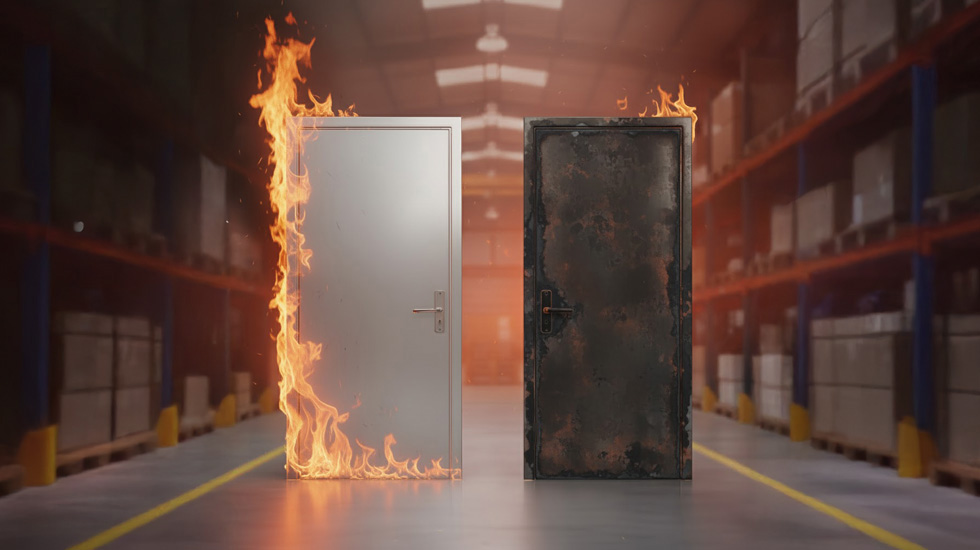

At a Glance: They Look the Same — But They’re Not
If you lined up a fire-rated door next to a standard steel door, most people wouldn’t tell them apart. Both appear to be heavy-duty, durable, and secure. However, what makes a fire door truly different lies inside — in its construction, materials, and purpose.
The Science Inside a Fire Door
A standard steel door provides physical security and insulation, but it’s not built to withstand extreme heat. Fire-rated doors, on the other hand, are engineered with specialised cores (often mineral-based or composite materials) that resist heat transfer. These materials delay the spread of flames and smoke, maintaining structural integrity for a specific period — often 30, 60, or 120 minutes.
This delay is critical. It can provide people adequate time to evacuate and emergency responders time to contain the situation before the fire reaches other sections of the building.
Different Purposes, Same Everyday Function
Despite their different internal makeups, fire-rated doors operate just like standard doors — they open, close, and lock normally.
That means businesses don’t have to compromise on functionality or convenience to gain fire protection. In fact, many fire-rated models from Larnec are pre-hung, fully steel-clad, and available in various sizes to suit sheds, warehouses, industrial facilities and commercial buildings.
Which Door Do You Really Need?
For offices or storage areas with lower fire risks, a standard steel door may meet your needs.
However, facilities that handle machinery, vehicles, or electrical systems often benefit from the added protection of a fire-rated door.
Before making a decision, it’s best to review the National Construction Code (NCC) to determine whether your building legally requires fire doors. This ensures your site meets compliance standards while keeping your people and property protected.
When safety and security are both priorities, a fire-rated door delivers both — peace of mind and proven protection.
Contact Us
Not sure which door suits your site? Talk to Larnec’s experts to choose the right steel or fire-rated door for your facility.
Frequently asked questions
Fire doors are designed to resist fire and smoke for a specified period, while standard steel doors are designed for general durability and access.
Fire doors are tested and certified as complete assemblies, whereas standard steel doors focus on strength, security, and everyday performance without fire resistance requirements.
You should choose a fire door when fire containment or compliance is required in the building design.
This typically applies to internal separations, plant rooms, and escape paths. Standard steel doors are suitable for general-purpose applications where fire rating is not required.
Fire doors can offer comparable or higher durability depending on their construction and application.
They are often built with reinforced cores and specialised components to support fire resistance. However, durability also depends on how the door is specified for the environment and usage.
Standard steel doors cannot simply be upgraded to become fire-rated unless they are part of a tested fire door system.
Fire-rated performance depends on the entire assembly, including the door leaf, frame, seals, and hardware. Purpose-built fire door systems are required to meet compliance standards.
The key factors include compliance requirements, building use, and environmental conditions.
If fire separation is required, fire doors are necessary. For general industrial or commercial applications, standard steel doors may be suitable, particularly where durability and access are the primary considerations.