



%402x.svg)
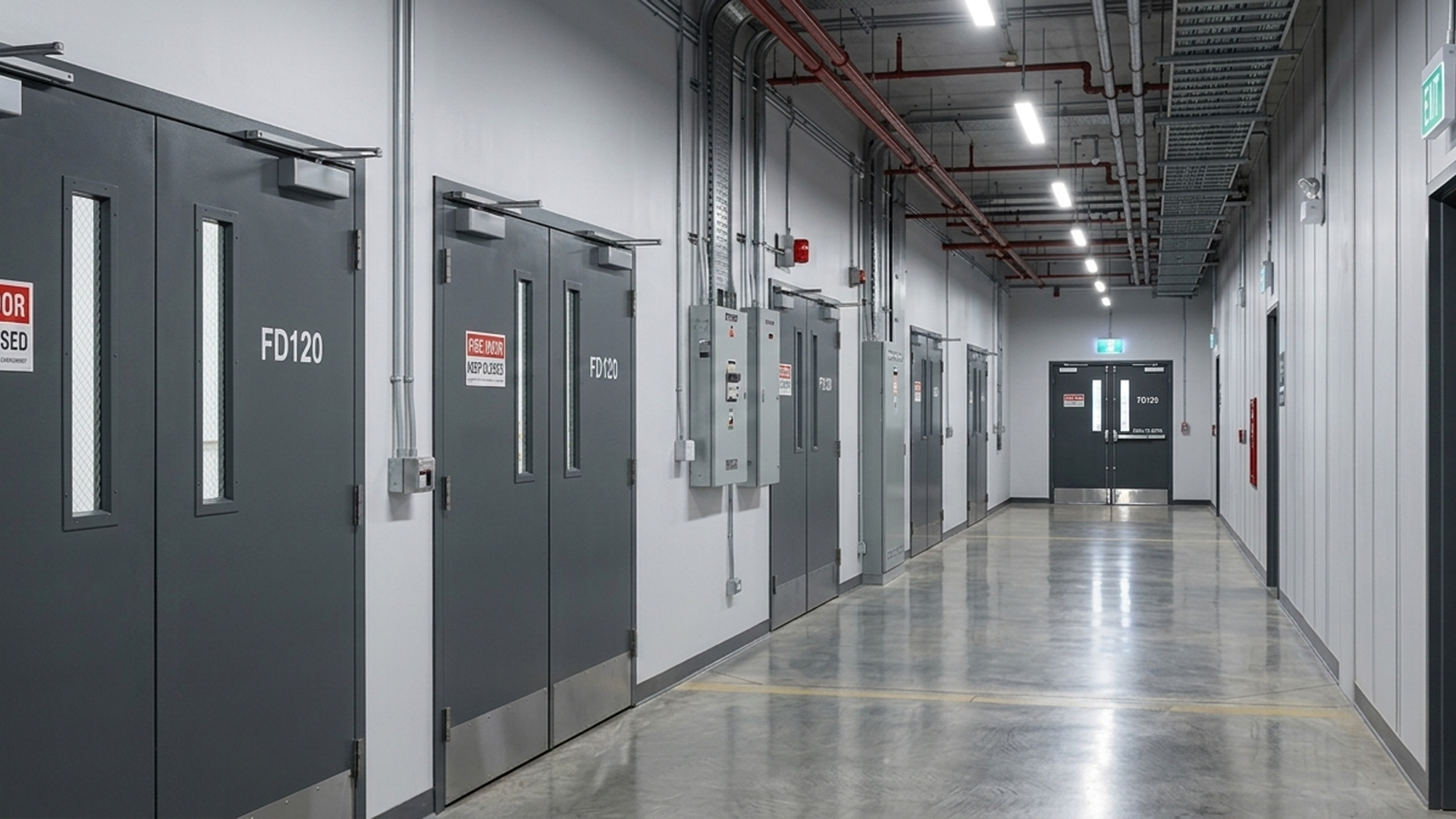

Fire doors are commonly used in commercial, industrial and multi-occupancy buildings to support compartmentation strategies and assist with managing the spread of fire and smoke between designated areas.
However, fire door compliance is often misunderstood. Requirements can vary depending on building classification, wall systems, hardware configuration, installation methods, and applicable project documentation.
This guide explores how fire doors are commonly specified in Australia, what factors can influence compliance pathways, and what building professionals typically consider when selecting a fire door system.
What Is a Fire Door?
A fire door is generally part of a tested door assembly designed to support passive fire protection strategies within a building.
A complete fire door assembly includes:
- Fire-rated door leaf
- Fire-rated frame
- Approved hardware
- Intumescent or smoke seals
- Self-closing devices
- Certified installation methods
Performance outcomes are typically based on the complete tested assembly rather than individual components alone.
Why Fire Doors Are Used in Commercial Buildings
Fire doors are commonly installed in areas where compartmentation or protected egress pathways form part of the building design.
Typical applications may include:
| Application Area | Common Purpose |
|---|---|
| Plant Rooms | Separation of higher-risk equipment areas |
| Stairwells | Protected egress pathways |
| Service Corridors | Fire compartmentation |
| Industrial Facilities | Separation between operational zones |
| Multi-Tenancy Buildings | Boundary protection between occupancies |
| Modular Buildings | Fire separation strategies in transportable structures |
Requirements can vary depending on building classification, occupancy type, and project documentation.
Understanding Fire Door Compliance in Australia
Fire door requirements in Australia are generally influenced by:
- National Construction Code (NCC)
- Relevant Australian Standards
- Building classification
- Fire engineering reports
- Architectural documentatio
- State-based requirements
Key compliance considerations often include:
| Compliance Area | Common Considerations |
|---|---|
| Fire Resistance Level (FRL) | Required fire separation duration |
| Hardware Configuration | Compatibility with tested systems |
| Door Closers | Self-closing functionality |
| Smoke Seals | Smoke management requirements |
| Frame Construction | Compatibility with wall systems |
| Installation | Correct fixing and assembly methods |
The final compliance pathway is usually determined by project-specific documentation and certified system configurations.
Fire Resistance Levels (FRLs) Explained
FRLs are commonly used to describe how long a building element may perform against criteria such as structural adequacy, integrity, and insulation during standardised testing conditions.
FRL=Structural Adequacy/Integrity/Insulation
Examples of FRLs often referenced in commercial projects include:
| Example FRL | Typical Context |
|---|---|
| -/60/30 | Certain internal separations |
| -/120/30 | Higher separation requirements |
| -/240/30 | Specific infrastructure or industrial applications |
Actual FRL requirements can vary depending on building design, wall systems, and engineering documentation.
Why Fire Door Hardware Matters
Fire door performance is not determined solely by the door leaf itself. Hardware selection may significantly influence whether a door assembly aligns with tested configurations.
Common fire door hardware may include:
- Fire-rated hinges
- Door closers
- Panic hardware
- Lever sets
- Smoke seals
- Latching systems
- Hold-open devices
- Vision panels
Some hardware combinations may only be suitable when included within tested door system configurations.
Common Fire Door Materials & Configurations
Commercial fire doors can be manufactured using different constructions depending on project requirements.
| Door Construction | Common Characteristics |
|---|---|
| Steel-clad Fire Doors | Often selected for industrial durability |
| Timber Fire Doors | Common in commercial interiors |
| Double Fire Doors | Used for larger openings and access pathways |
Suitability may vary depending on wall construction, traffic volume and environmental conditions.
Fire Door Installation Considerations
Correct installation is often critical to how a fire door assembly performs.
Installation factors may include:
- Wall type compatibility
- Frame anchoring
- Clearance tolerances
- Seal installation
- Hardware positioning
- Door closer adjustment
Even tested systems may require specific installation methodologies to align with project requirements.
Common Fire Door Compliance Mistakes
Several issues can affect fire door performance or certification pathways over time.
| Common Issue | Potential Impact |
|---|---|
| Incorrect Hardware Replacement | May affect tested assembly configuration |
| Damaged Seals | Reduced smoke or fire separation performance |
| Excessive Gaps | May impact integrity performance |
| Improper Modifications | Can alter tested system behaviour |
| Disabled Door Closers | May affect self-closing functionality |
Ongoing inspection and maintenance programs are commonly recommended in commercial buildings.
Fire Doors in Different Industries
Industrial Facilities
Industrial projects often prioritise durability, operational reliability and configurable hardware options.
Healthcare Buildings
Healthcare environments may require fire separation strategies while also supporting accessibility and operational flow.
Data Centres & Infrastructure
Fire doors in mission-critical infrastructure environments may be selected alongside thermal, and access control considerations.
Modular & Transportable Buildings
Fire-rated systems may be integrated into modular construction depending on project scope and building requirements.
Fire Door Certification & Documentation
Commercial projects commonly require supporting documentation relating to fire door systems.
Documentation may include:
- Test reports
- Certification documentation
- Product specifications
- Installation records
- Maintenance records
- Hardware schedules
Requirements can vary between projects, certifiers and jurisdictions.
| Specification Area | Questions to Consider |
|---|---|
| Building Type | What classification applies? |
| FRL Requirements | What separation duration is required? |
| Wall System | What wall construction is being used? |
| Hardware | What operational hardware is required? |
| Traffic Volume | Will the opening experience heavy use? |
| Accessibility | Are accessibility considerations required? |
| Environment | Internal, external or corrosive conditions? |
| Documentation | Are certification records required? |
Final Thoughts
Fire door compliance is often influenced by more than the door leaf itself. Hardware configuration, wall construction, installation methodology and project documentation can all contribute to how a fire door assembly is assessed within a commercial building.
Whether specifying doors for industrial facilities, modular buildings, healthcare projects or commercial developments, understanding the broader system requirements can help support more informed specification decisions.
If you are reviewing fire door options for an upcoming project, discussing with our team of experts the operational requirements, environmental conditions and hardware expectations early may help identify more suitable configuration pathways for your application.
Frequently asked questions
No. Fire-rated doors are typically specified only where fire separation or protected egress pathways are required within the building design.
Compliance generally depends on the complete tested assembly, including the door, frame, seals, hardware and installation methodology.
Some fire door systems can be configured with different hardware, finishes and accessories depending on tested system limitations and project requirements.
Commercial fire doors are commonly included within ongoing inspection and maintenance programs to help support long-term operational performance.
In some cases, replacing or modifying hardware may affect how a tested assembly aligns with certification documentation.