



%402x.svg)
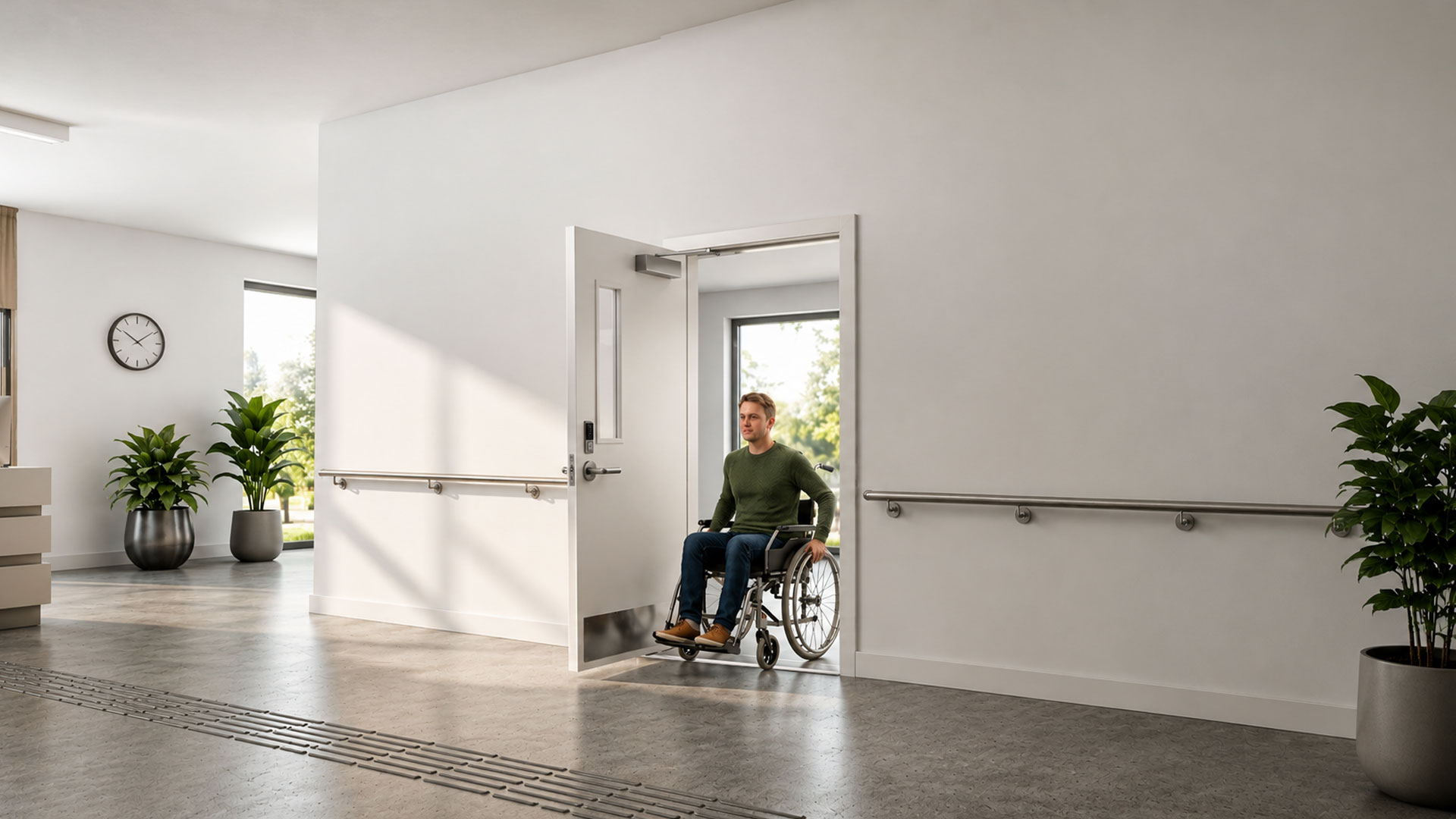

Door width gets a lot of the attention in accessibility conversations, and for good reason. It’s the number that shows up in the standard, the number that determines whether a project passes inspection. But width is only half the story. The other half is what happens when someone actually reaches the door: can they open it, get through it, and close it behind them without a fight?
That’s where hardware comes in. A well-specified lever handle, a properly tuned closer, or a keyless entry system can make a doorway genuinely easier to use for a wheelchair user, an elderly staff member, a parent pushing a pram, or anyone with their hands full. And unlike width, hardware upgrades apply just as much to an 820mm door as they do to a 920mm one. If you haven’t read it yet, our article on disability-compliant door widths covers the AS 1428.1 clearance requirements in detail. This one picks up where that left off.
Width Gets You Compliant. Hardware Gets You Usable.
Here’s the distinction worth sitting with: width compliance is a pass/fail measurement that matters for regulated buildings on an accessible path of travel. Usability is a spectrum, and it matters everywhere, including the industrial sheds, portable buildings, and commercial fit-outs where a full 850mm clearance isn’t always required or practical.
An 820mm door with a light-action closer, a proper lever handle, and low opening force can be easier to use day to day than a wider door with a stiff closer and a knob handle. Both conversations matter. They’re just not the same conversation.
Lever Handles: Getting the Basics Right
Our earlier article touched on lever handles briefly, but it’s worth going further, because there’s more to specifying one than just “not a knob.”
- Grip and reach. A lever needs enough length and a wide enough grip diameter to be operated with a closed fist, an elbow, or the side of a hand, not just fingers. This matters for anyone with limited grip strength or dexterity.
- Return-to-wall design. Levers that curve back toward the door face reduce the risk of clothing, bag straps, or a passing wheelchair catching on them. It’s a small detail that avoids a real hazard in high-traffic doorways.
- Height. AS 1428.1 calls for handles between 900mm and 1100mm, with 1000mm the commonly preferred figure. This is the baseline, not the finish line: a correctly positioned lever combined with the wrong grip shape still creates friction for the person using it.
Door Closers: The Setting Most People Never Adjust
Closers are one of the most overlooked pieces of accessible door hardware, largely because most people don’t know they’re adjustable at all.
AS 1428.1 specifies a maximum opening force, generally 20N for standard doors and up to 38N for fire doors (fire doors need enough closing force to seal properly, which is part of why they’re harder to open by design). A closer set well above these figures can make an otherwise compliant doorway genuinely difficult for a wheelchair user or someone with limited upper body strength to operate.
Two features worth specifying:
- Adjustable closing force, tuned to the lowest setting that still lets the door close and latch reliably.
- Delayed-action closing, which holds the door open briefly before it begins to swing shut. This gives a wheelchair user or someone using a walking frame time to clear the opening fully, rather than racing a door that’s already closing.
Keyless Entry: An Accessibility Upgrade That Doubles as an Operational One
Turning a key is a fine-motor task. It asks for grip strength, wrist rotation, and precision, none of which are guaranteed, especially for older staff, visitors with arthritis, or anyone managing an injury. Keypad or keyless entry removes that step entirely: a palm press or a card tap replaces the twist-and-turn.
It’s also an easy one to sell beyond accessibility, which is worth knowing if you’re the one specifying it into a project. No lost keys, no rekeying when staff turnover, and straightforward access control for sites that need to track who’s coming and going. It’s an accessibility feature that pays for itself operationally, which makes it a much easier line item to justify.
Power-Assisted and Automatic Operators: Where They Actually Make Sense
Automatic and power-assisted door operators are the most visible accessibility hardware, and also the easiest to over-specify. They’re genuinely valuable in high-traffic commercial settings, healthcare facilities, and aged care, anywhere doors are used constantly by people who may not have a free hand or the strength to manage a swing door unassisted.
They’re generally overkill for most shed, garage, and industrial applications, where a well-tuned manual closer and the right lever handle will do the job without the added cost and maintenance of a powered system. Worth knowing where the line sits so you’re recommending the right solution for the project, not the most expensive one.
Thresholds: A Quick Recap
We covered this in detail in the original article, so just the essentials here: sills should sit at 5mm or lower for accessible doorways, and where a threshold is unavoidable, a ramped sill design keeps the transition smooth for wheelchairs while still managing water ingress. See our earlier piece for the full breakdown.
Upgrading Existing Doors
Not every accessibility improvement means replacing the door. In a lot of cases, particularly for shed manufacturers and industrial sites working within a fixed budget, hardware retrofits get you most of the way there without a full doorset replacement:
- Swapping a knob for a compliant lever handle
- Adjusting or replacing a closer to bring opening force into range
- Adding a keyless entry system to an existing door
- Fitting a ramped sill over a raised threshold
It’s a practical way to improve usability across an existing building without waiting for a renovation or new build to justify the spend.
Talk to Your Account Manager
Larnec supplies a full range of hardware and accessories, from lever handles and adjustable closers through to keyless entry systems, designed to work across our personal access door range. If you’re specifying a project with accessibility requirements, or just want doors that are genuinely easier to use, talk to your account manager or get in touch with our team to find the right hardware for the job.
Frequently asked questions
Not always. Width is required for full AS 1428.1 compliance on regulated accessible paths of travel, but hardware such as lever handles, adjustable closers, and keyless entry can meaningfully improve usability on any door, regardless of width.
AS 1428.1 generally specifies a maximum of 20N for standard doors and up to 38N for fire doors, which need extra closing force to seal correctly.
Yes. Most closers have adjustable closing force and closing speed, and some offer delayed-action closing to give wheelchair users or those with limited mobility more time to clear the doorway.
Yes. Keyless and keypad entry remove the fine-motor demands of turning a key, making doors easier to use for people with limited grip strength or dexterity, while also simplifying access control.
Not in most cases. They’re valuable in high-traffic commercial, healthcare, and aged care settings, but a well-specified manual closer and lever handle meet accessibility needs in most shed, garage, and industrial applications.
In most cases yes. Lever handles, closers, keyless entry, and ramped sills can typically be added to existing doors without replacing the full doorset.