



%402x.svg)
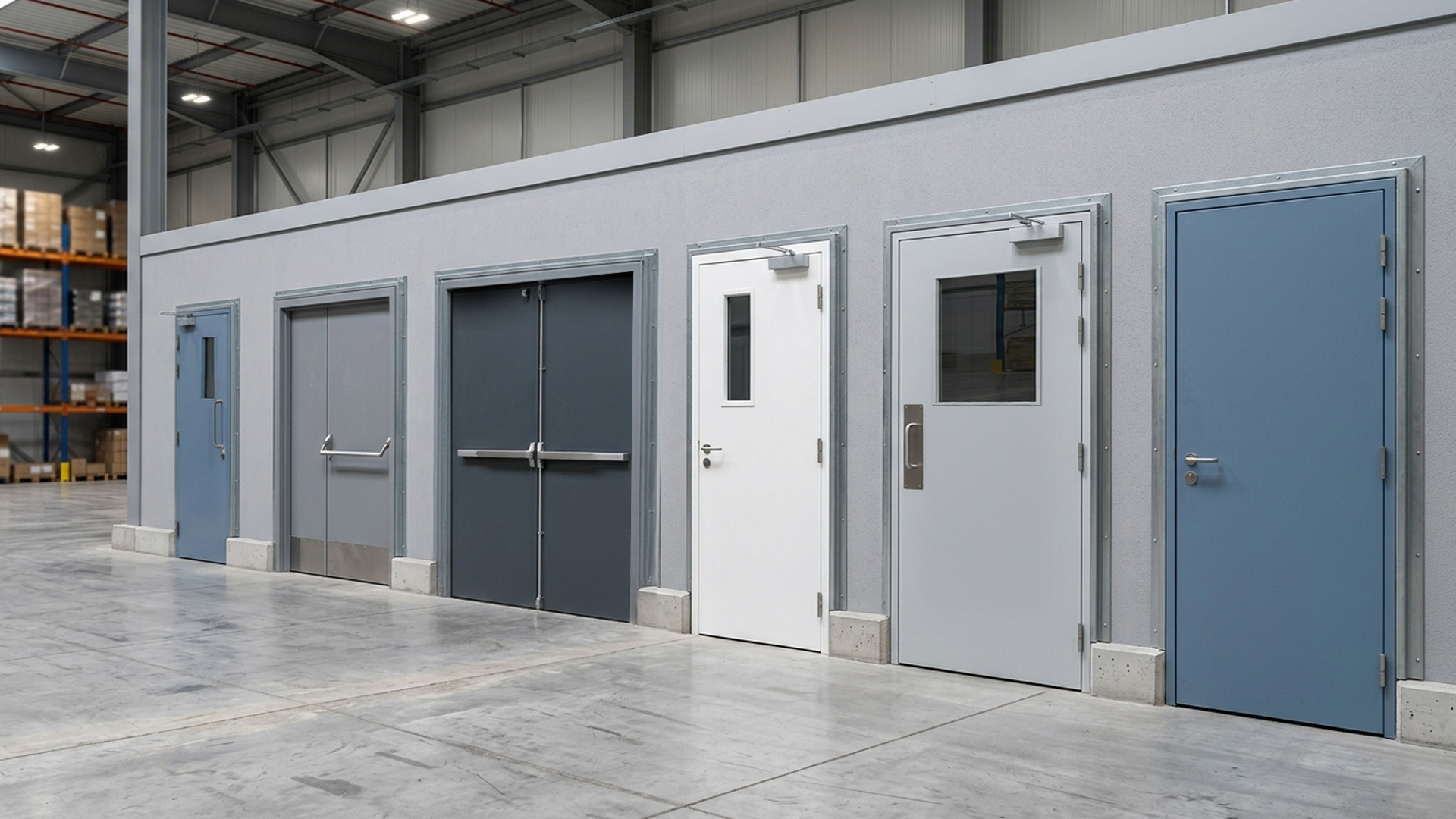

When planning a project—whether it’s an industrial shed, modular building, or commercial facility—door sizing and configuration decisions often seem straightforward… until they’re not.
“Standard” can mean different things depending on the application, and choosing the right configuration early can save time, cost, and frustration during installation.
This guide breaks down what standard door sizes actually mean in Australia, what configuration options are available, and when a custom solution may be worth considering.
Quick Answer: What Are Standard Door Sizes in Australia?
For most industrial and commercial applications in Australia, common personal access door sizes include:
- 2040mm (H) x 820mm (W) – most common
- In Australia, disabled (accessible) compliant doors have 850mm (W) clear door opening
- 2040mm (H) x 920mm (W) – wider access
- 2040mm (H) x 1100mm (W) – high-traffic or equipment access
These sizes are widely used across sheds, warehouses, and modular buildings because they align with common framing and construction practices.
However, “standard” is best thought of as a starting point—not a limitation.
What Does “Standard” Actually Mean?
In practice, “standard door size” refers to:
- Commonly manufactured dimensions
- Sizes that suit typical wall openings
- Configurations that are readily available and cost-effective
But in real-world projects, doors are rarely chosen in isolation. They are influenced by:
- Wall construction and framing
- Access requirements (people, equipment, pallets)
- Hardware selection (locks, closers, panic hardware)
- Environmental conditions (wind exposure, usage frequency)
That’s why standard sizes are often adapted or configured rather than used exactly as-is.
Common Door Configurations Explained
Beyond size, configuration plays a major role in how a door performs on-site.
1. Single Doors (Most Common)
- One leaf, typically in standard widths (820–1100mm)
- Suitable for general personal access
- Can be configured with various hardware options
Best for:
Sheds, warehouses, plant rooms, and general access points
2. Double Doors
- Two door leaves opening from the centre
- Can include equal or unequal leaf sizes
- Often paired with different hardware setups
Best for:
Wider openings, equipment access, or higher traffic areas
3. Left-Hand vs Right-Hand Opening
Door handing affects installation and usability:
- Left-hand opening – hinges on the left
- Right-hand opening – hinges on the right
This is usually determined by:
- Site layout
- Safety considerations
- Workflow direction
4. Inward vs Outward Opening
Doors can be configured to open:
- Inward – common for internal or sheltered applications
- Outward – often preferred for external doors or where space is limited
The choice depends on:
- Available clearance
- Safety requirements
- Environmental exposure
5. Pre-Hung Door Systems
Pre-hung doors come complete with:
- Frame/jamb
- Hinges
- Pre-prepared hardware cut-outs
These systems are designed to support:
- Faster installation
- More consistent fitment
- Reduced on-site adjustments
When Standard Sizes May Not Be Enough
While standard sizes work for many applications, there are situations where adjustments or customisation may be considered:
1. Non-Standard Openings
Older structures or modular builds may not align with typical dimensions.
2. Specific Access Needs
Projects involving:
- Trolleys or equipment
- High foot traffic
- Accessibility considerations
…may benefit from wider or differently configured doors.
3. Environmental Factors
Wind exposure, usage frequency, and location can influence:
- Door construction
- Hardware selection
- Installation method
4. Integration with Other Systems
Doors may need to work alongside:
- Access control systems
- Closers or hold-open devices
- Safety hardware
In these cases, a configured solution often makes more sense than forcing a standard size to fit.
| Scenario | Suitable Approach |
|---|---|
| Typical shed or warehouse access | Standard size with basic configuration |
| High-traffic or equipment access | Wider or double-door configuration |
| Unique opening or retrofit | Adjusted or custom sizing |
| Specific hardware requirements | Configured solution |
Most projects fall somewhere in between—using a standard base size with tailored configuration.
How to Choose the Right Door for Your Project
Before making a decision, it helps to clarify:
- Opening size (rough opening, not just door leaf)
- Type of access required (people, equipment, frequency)
- Preferred opening direction
- Hardware needs (locks, closers, etc.)
- Environmental conditions
Even a simple checklist like this can significantly reduce back-and-forth during quoting and ordering.
Why Getting This Right Early Matters
Choosing the right size and configuration upfront can help:
- Avoid costly site modifications
- Reduce installation time
- Improve usability for end users
- Streamline procurement and lead times
It also helps ensure you’re getting a door that is suited to the application, rather than one that simply “fits”.
A Flexible Approach to Door Solutions
No two projects are exactly the same, which is why door solutions are often configured rather than selected off the shelf.
At Larnec, door options are designed to support a wide range of applications—from standard sizes to more tailored configurations—depending on what the project requires.
If you’re unsure what will work best, it’s usually easiest to start with your opening size and intended use, and build from there.
Need Help Choosing the Right Door?
If you’re planning a project and want clarity on sizing or configuration options, it can help to talk through your requirements early.
Whether you’re working with standard dimensions or something more specific, getting guidance upfront can save time and help ensure the door suits your application.
Have a question or project in mind? Get in touch with the team on 1800 527 632 or submit an enquiry through the website.
Frequently asked questions
Standard door sizes in Australia typically refer to commonly available dimensions such as 2040mm high by 820mm, 920mm, or 1100mm wide. These sizes are widely used across industrial and commercial applications, although the final selection often depends on the opening, access needs, and overall project requirements.
A more customised solution may be considered when the opening is non-standard, when wider access is required, or when specific hardware or environmental factors need to be taken into account. Many projects use a combination of standard sizing with tailored configuration.
Key considerations include the size of the opening, the type and frequency of access, preferred opening direction, and any hardware requirements. Environmental conditions and the surrounding structure may also influence the most suitable configuration.